

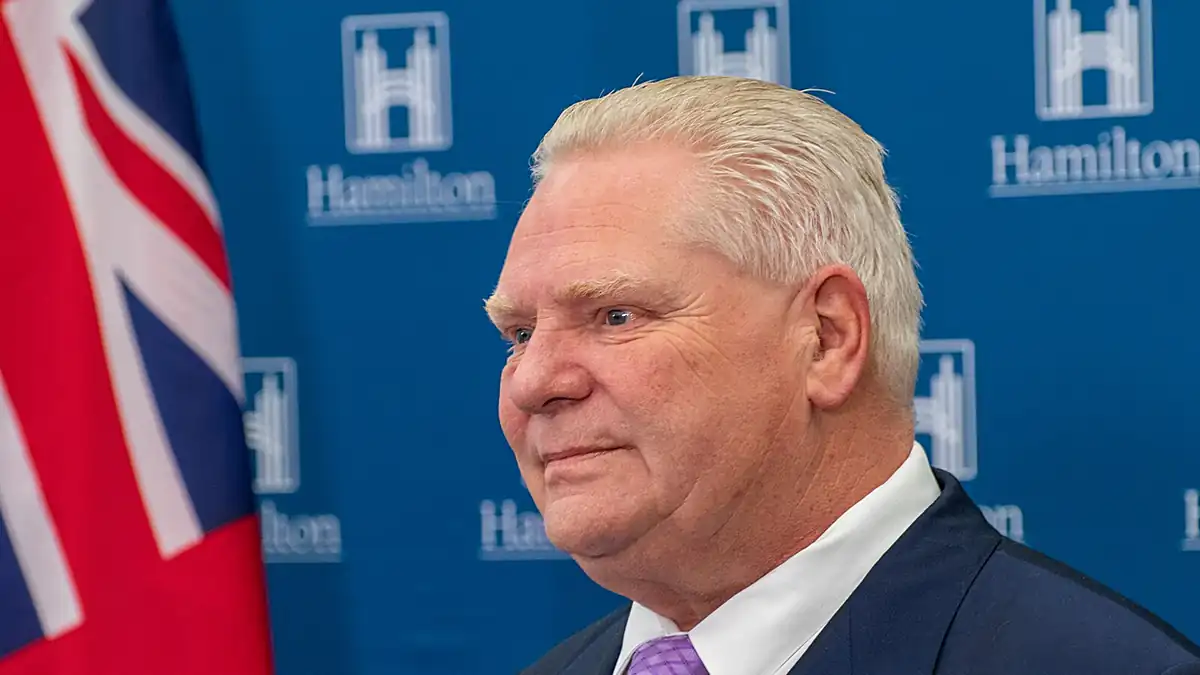
Ontario Premier Doug Ford and Unifor national president Lana Payne attacked Canada’s new trade deal with China on Jan. 16, 2026, saying the agreement to admit up to 49,000 Chinese electric vehicles a year at a 6.1% tariff endangers Ontario auto jobs and offers no guaranteed Chinese investment in return.
‘A terrible, miscalculated decision’
Hours after Prime Minister Mark Carney announced the deal in Beijing, Ford told reporters it would be “terrible, for not only just all the people of Ontario, but especially the auto manufacturers, the supply chain.”
Under the agreement, Canada slashes its 100% tariff on Chinese EVs for a quota of up to 49,000 vehicles a year. In exchange, China drops or significantly reduces its retaliatory tariffs on Canadian agricultural products, including canola seed and meal, pork, seafood and peas. Carney framed the pact as a strategic partnership that “reflects the world as it is today.”
Ford called the deal lopsided. He warned it risks closing the U.S. market to Canadian automakers, raised security concerns about Chinese-built vehicles, and argued the cars are produced at artificially low cost. “It’s just a terrible, terrible, miscalculated decision by the Prime Minister,” he said. “They’re heavily subsidized, totally against all the autoworkers here in Ontario.”
Unifor calls it a self-inflicted wound
Unifor, Canada’s largest private-sector union, representing thousands of autoworkers, took the same position. National president Lana Payne said the deal rewards labour violations and unfair trade practices. “This is a self-inflicted wound to an already injured Canadian auto industry,” she said in a news release. “Finding a resolution to U.S. auto tariffs just got more difficult.”
Ontario NDP Leader Marit Stiles joined the attack, posting: “Let me be clear: Mark Carney is selling out our auto sector. Our workers deserve guarantees — you don’t protect an industry with maybes.”
The pressure point for both critics was the absence of firm commitments. Ottawa says it expects the deal to drive “considerable” Chinese joint-venture investment in Canada within three years, creating auto manufacturing jobs — but nothing in the agreement guarantees it.
Ottawa’s case, and a cooler assessment
The federal government notes the 49,000 vehicles amount to less than 3% of Canada’s new-vehicle market, and match the volume of Chinese-built EVs imported in 2023–24 before Canada followed the U.S. in imposing the 100% tariff. Ottawa also says it anticipates that within five years half the quota vehicles will have an import price under $35,000, with the quota rising to 70,000.
Greig Mordue, a McMaster University engineering professor and former general manager of Toyota’s Canadian division, offered a calmer read. The quota approach mirrors how Ottawa handled the rise of Japanese automakers in the early 1980s before using their sales as leverage for Canadian plants, he noted. “This has virtually no impact on Canadian production,” Mordue said, adding the quota may be too small to draw Chinese brands in at all, beyond more China-built Teslas, Polestars and Volkswagens.
Ford was unmoved, pointing to Europe, where Chinese-built EVs climbed from 3.9% of the market in 2020 to 25% by September 2023 before the EU imposed tariffs of up to 35.3%. “They start off with always saying three per cent,” he said. “Ask people in Brazil what happens to three per cent; turns into 37 per cent.”
The fight continued the following week
The Jan. 16 reaction set the tone for a running battle. On Jan. 21, Ford stood with the heads of the Canadian Vehicle Manufacturers’ Association, the Automotive Parts Manufacturers’ Association and Unifor to urge Canadians to boycott Chinese EVs and buy from companies that build vehicles in Canada, and to press Ottawa for measures to cut the cost of investing in domestic plants. China’s ambassador to Canada, Wang Di, responded on Jan. 23 that Beijing wants to partner with Canadian autoworkers to create jobs and build cheaper cars. The quota, and the argument over it, are now fixtures of the Canada-China reset.

