

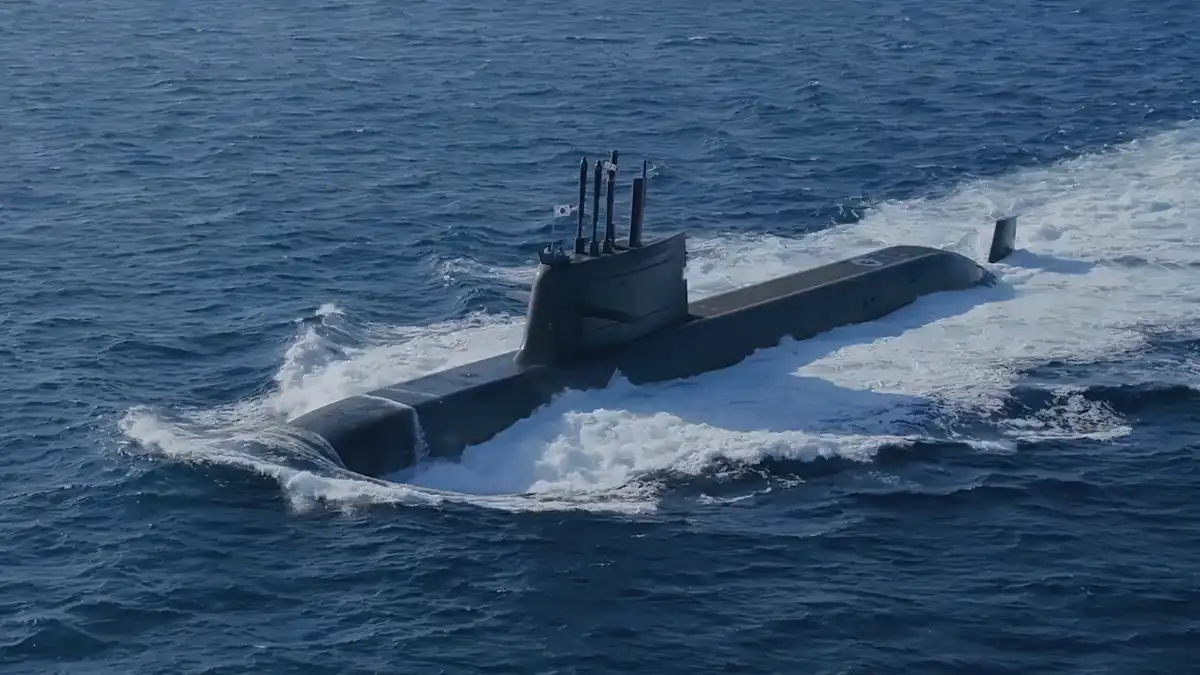
South Korea’s Hanwha Ocean has blanketed Ottawa with billboards, bus ads, airport displays and streaming spots promoting its KSS-III submarine. The campaign is aimed at making Hanwha a household name in the capital while it competes with Germany’s TKMS to build Canada’s next fleet of patrol submarines.
Selling submarines like smartphones
Ottawa residents have puzzled in recent months over orange-hued advertisements for a product no shopper can buy: a roughly 300-foot submarine. The ads, placed by South Korean shipbuilder Hanwha Ocean, tout its KSS-III submarine as the “best economic plan for Canada” and promise fast delivery and maintenance services in this country.
A video on Hanwha’s YouTube channel scales the KSS-III Batch II boats against familiar Canadian landmarks, including the ice at Montreal’s Bell Centre and the baseball diamond at Toronto’s Rogers Centre. Prospectus Associates, the firm handling Hanwha’s public relations in Canada, declined to say what the campaign cost.
“The Canadian Patrol Submarine Project will be one of Canada’s largest procurements ever, so we want Canadians to know about Hanwha and understand that the company is one of the largest and most advanced shipbuilders in the world,” said senior partner Keelan Green, adding the goal is to put Hanwha in the same league as Samsung, LG and Hyundai.
Ottawa narrowed the competition last fall to Hanwha and Germany’s ThyssenKrupp Marine Systems. The navy wants up to 12 new submarines to replace its four aging Victoria-class boats, with deliveries starting in 2035, and Ottawa has committed to awarding the contract before 2028.
Marketing as a procurement weapon
Defence and marketing experts say the campaign is unusual but not irrational. “It’s less about selling a specific product and more about shaping a particular perception, a public imagination, normalizing military tech as necessary,” said Markus Giesler, a marketing professor at York University’s Schulich School of Business.
Philippe Lagasse, a Carleton University defence policy professor, noted that the Carney government has said the winning bid will be judged partly on economic benefits for Canada, such as domestic jobs and maintenance contracts. In that environment, he said, street-level marketing that builds a favourable “atmosphere” can percolate up to the politicians who make the final call.
Hanwha is not alone on Ottawa’s walls. Sweden’s Saab recently posted a banner near Parliament Hill for its GlobalEye surveillance aircraft, and Halifax-based Irving Shipbuilding ran a billboard promoting its role in the River-class destroyer program. TKMS, by contrast, did not respond to questions about its own marketing; Germany’s defence minister visited Ottawa in October as part of Berlin’s charm offensive, and Prime Minister Mark Carney toured both rival shipyards during trips to Germany and South Korea last year.
The campaign was only the opening act
The advertising war foreshadowed how public the submarine fight would become. Hanwha went on to pledge more than $70 billion in trade and investment and roughly 25,000 jobs a year in Canada, and sailed a KSS-III submarine to British Columbia in May 2026 so Canadian officials could see it up close.
In July 2026, Ottawa announced it had chosen TKMS and its Type 212CD boats for the fleet, a program expected to cost up to $60 billion for the vessels alone. Hanwha did not leave empty-handed in one respect: its KSS-III remains the official reserve design, which Canada can turn to if contract negotiations with TKMS break down.

