

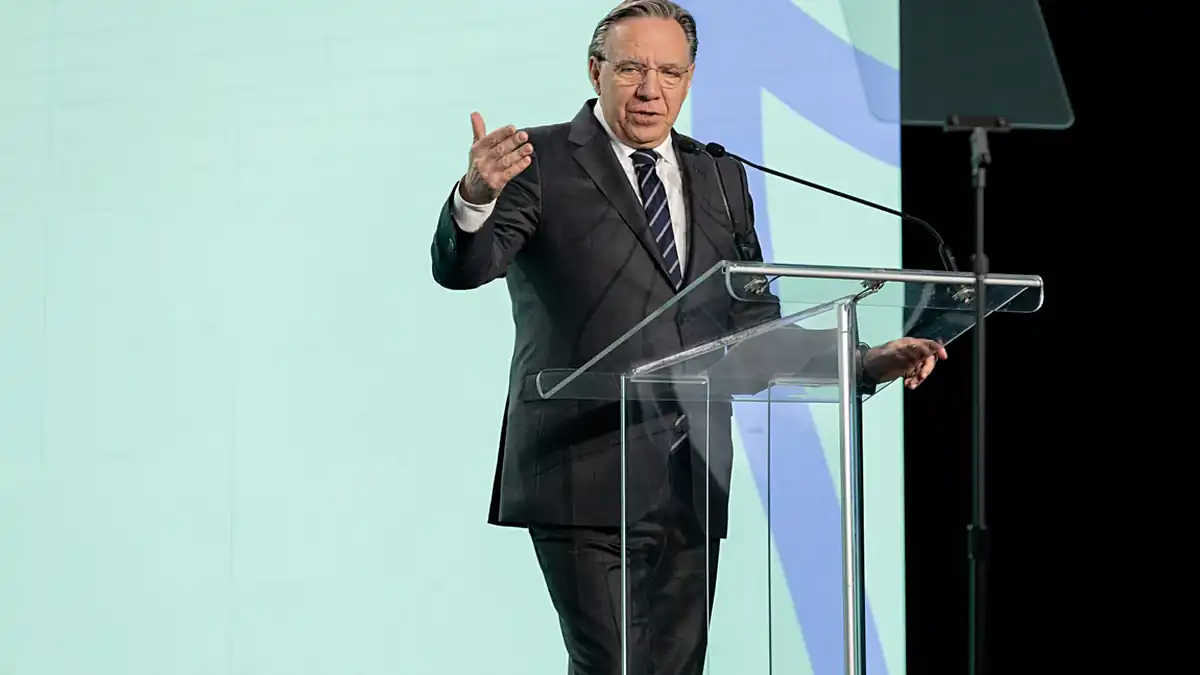
Quebec Premier François Legault, speaking to reporters on Jan. 21, 2026 for the first time since announcing his resignation, said the Coalition Avenir Québec he co-founded remains the best party to grow the economy and protect the French language, and that it will stay relevant after a new leader replaces him.
‘It’s even more relevant than ever’
Legault told reporters in Quebec City on Wednesday that the CAQ remains the best party to balance the needs of the economy and protect the French language.
“The CAQ, when you look at Article 1 … it’s prosperity within Canada, but while seeking more autonomy to defend our language, defend our values,” he said. “So it’s even more relevant than ever.”
Legault formed the party in 2011 as an alternative to the federalist-sovereigntist divide that had dominated Quebec politics for decades, promising a formation that would fight for greater provincial strength while removing the threat of another referendum. The CAQ went on to win majority governments in 2018 and 2022.
He announced on Jan. 14 that he would step down as premier and party leader ahead of October’s provincial election, saying he could see that many Quebecers wanted change. He will remain in both roles until the party chooses a successor in its first-ever leadership race.
A coalition built around one man
Since the resignation, analysts have questioned whether the coalition Legault assembled — a mix of former federalists and former sovereigntists — can hold together without him, especially with the poll-leading Parti Québécois threatening to hold a referendum in its first term if elected. A Léger poll in December put the PQ at 35 per cent support, with the CAQ third at 19 per cent.
Legault said Wednesday there is still room for sovereigntists in his party, as long as they accept working within Canada. “One can be sovereigntist and think that it’s not the right moment, or there isn’t a majority of Quebecers,” he said.
He argued the Parti Québécois would create economic uncertainty, and that the official Opposition Liberals won’t do enough to reverse the decline of French in the Montreal area. “We need the CAQ to meet those two challenges,” he said.
Departures, but ‘the strongest team’
The party has yet to announce the rules of its leadership race, and no candidate had officially declared by Wednesday, though Economy Minister Christine Fréchette, Justice Minister Simon Jolin-Barrette and Environment Minister Bernard Drainville had all said they were considering a run.
Finance Minister Eric Girard officially bowed out of leadership contention on Wednesday, but said he planned to run for a third term in October. Two other high-profile ministers whose names had circulated — Municipal Affairs Minister Geneviève Guilbault and Education Minister Sonia LeBel — announced in recent days that they would not run and would leave politics at the end of the current term.
Legault said a certain number of political departures are to be expected. “Politics is tough, it requires a lot of sacrifices, but when I look at the team that remains in the CAQ right now, we have nothing to envy anyone,” he said. “We have a very strong team and I’m very confident about what’s to come.”
No prorogation, no endorsement
Legault also said he is not currently planning to prorogue the session of the legislature that opens next month, because he feels its work can continue despite the CAQ leadership race. And he said he wouldn’t endorse anyone in the race to succeed him.
The next Quebec election must be held by Oct. 5, 2026.

