

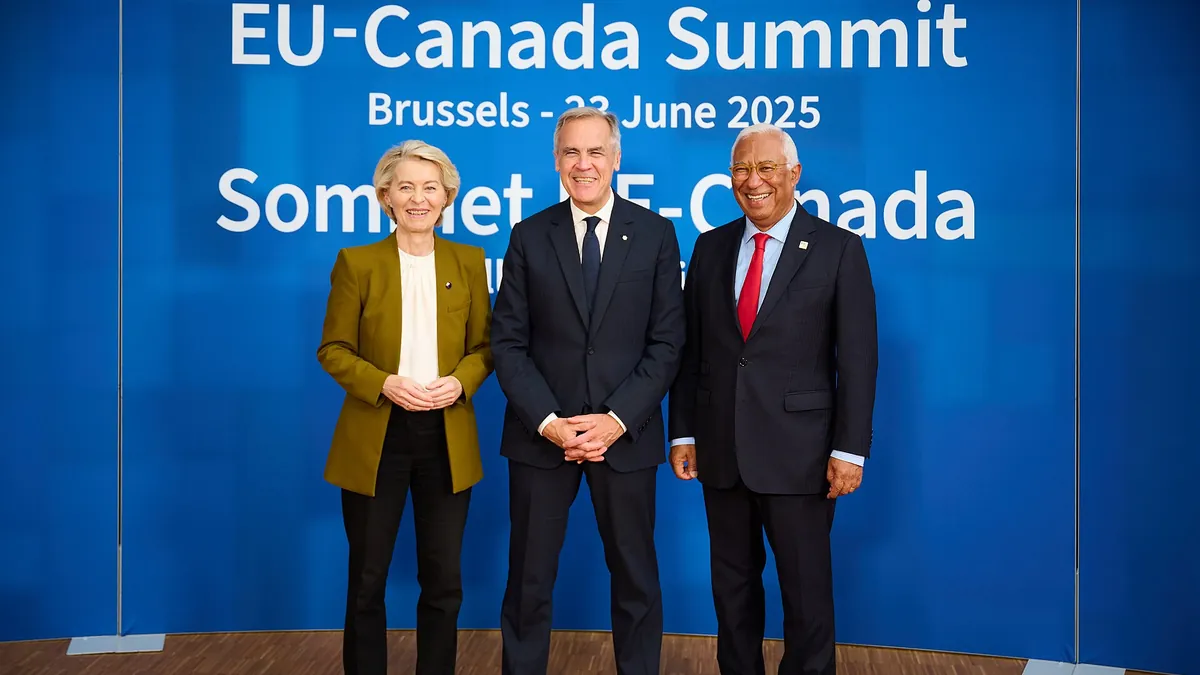
Canada and the European Union are closing in on a Canada-EU digital trade agreement, International Trade Minister Maninder Sidhu said Thursday, as negotiators push to finish the talks before next week’s Canada-EU summit in Montréal. The deal would set shared rules for online commerce between the two markets.
What the Canada-EU digital trade agreement would cover
Sidhu said the two sides are “closing in on an agreement” that would create less friction for businesses buying and selling online across the Atlantic. In a statement issued during his trip to Ireland, the minister pointed to electronic signatures and electronic contracts, paperless trade, secure cross-border data flows, customs duties on electronic transmissions and e-commerce as the areas on the table.
EU Trade Commissioner Maroš Šefčovič, speaking in Dublin on Thursday, added electronic invoices to that list and said the agreement would strengthen protection for online consumers. The final text has not been published, and neither side has released a complete account of what the finished agreement will contain.
The stakes are already measurable. Sidhu said Canada exported nearly $15 billion in digital services to the EU in 2024, a figure he cited as evidence of how much room the trade has to grow once common rules are in place.
A Dublin push days before the Montréal summit
Sidhu travelled to Ireland this week for an informal meeting of EU trade ministers, where he met Šefčovič and Ireland’s foreign affairs and trade minister, Helen McEntee. The visit also marked 10 years since Canada and the EU signed CETA, their main trade agreement.
Šefčovič said Thursday the negotiations were “very close to the finish line” and that both sides aimed to conclude them ahead of the summit. Canada hosts the Canada-EU Summit in Montréal on Oct. 29 and 30, where Prime Minister Mark Carney will meet the EU’s leaders and the two sides are expected to announce the next steps in the partnership. A finished digital trade agreement would give the summit a concrete economic result to point to.
Built to complement CETA, not replace it
The digital agreement is designed to sit alongside the Canada-EU Comprehensive Economic and Trade Agreement rather than replace it. CETA has been provisionally applied since Sept. 21, 2017, and Global Affairs Canada credits it with lifting bilateral merchandise trade close to 80 per cent above pre-CETA levels. But the deal was negotiated before online commerce reached its current scale, and the European Commission has acknowledged it does not provide comprehensive rules on digital trade.
Ottawa and Brussels agreed at their June 2025 summit to work toward a separate digital pact, and Sidhu and Šefčovič formally launched the negotiations in March of this year. Five rounds of talks followed between April and September, and the Commission has published its own textual proposal. The result, if the talks close, would be Canada’s first standalone digital trade agreement.
A diversification play with the United States in the background
The timing is not accidental. The push with Europe is part of Carney’s effort to deepen ties with partners beyond the United States while U.S. tariffs squeeze Canadian exporters. Carney has set a goal of doubling Canada’s non-U.S. trade within a decade, an ambition he carried to Davos earlier this year, where he urged middle powers to band together.
Canada has already felt how exposed digital policy can be. Ottawa halted its planned digital services tax after U.S. President Donald Trump threatened tariffs over it. A rules-based deal with Europe would give Canadian firms a large market where the digital rulebook is settled in advance.
European Commission President Ursula von der Leyen went further in September, suggesting Canada could become the EU’s first associate member. A draft summit statement circulated last month spoke of a broader “Alliance for the Future” covering artificial intelligence, cybersecurity and supply chains, and even described the digital negotiations as completed. Officials on both sides were more careful this week. The deal is close, they say — and, as of Thursday, not quite done.

