

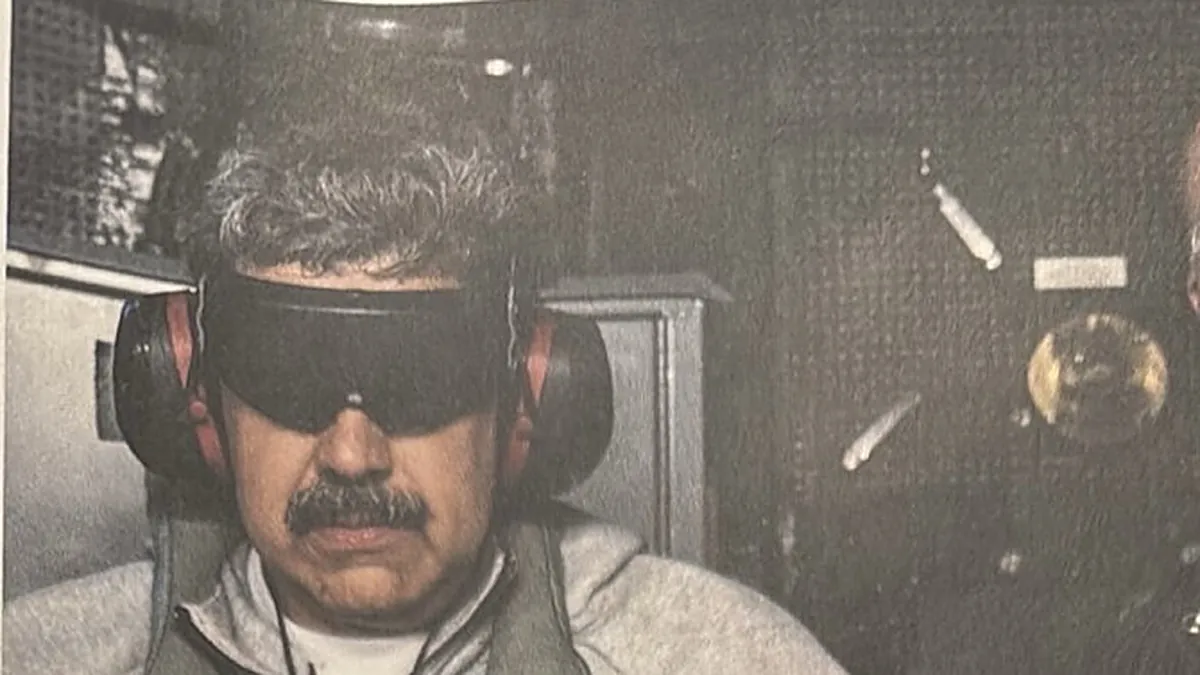
Canada called on all parties to respect international law after U.S. forces captured Venezuelan President Nicolás Maduro in Caracas on Jan. 3, 2026. Foreign Affairs Minister Anita Anand and Prime Minister Mark Carney backed a peaceful, Venezuelan-led transition, while Conservative Leader Pierre Poilievre congratulated Donald Trump on the arrest.
A predawn raid, and a fast-moving day
Explosions were heard over the Venezuelan capital around 2 a.m. on Saturday, as U.S. forces struck Caracas and seized Maduro and his wife, Cilia Flores. Shortly after 4:30 a.m. ET, U.S. President Donald Trump announced the United States had carried out a “large-scale strike” and captured the couple.
U.S. Attorney General Pam Bondi said Maduro and Flores had been indicted in the Southern District of New York and would “soon face the full wrath of American justice on American soil in American courts.” Trump told reporters the United States would “run” Venezuela until a transition could take place — Washington’s most direct intervention in Latin America since the 1989 invasion of Panama.
Ottawa walks a careful line
Canada’s response came in two steps, and it named no names. Foreign Affairs Minister Anita Anand issued the first statement on Saturday morning, stressing that Canada has refused to recognize the legitimacy of the Maduro regime since 2019 and has opposed its repression of the Venezuelan people.
“In keeping with our long-standing commitment to upholding the rule of law and democracy, Canada calls on all parties to respect international law and we stand by the people of Venezuela and their desire to live in a peaceful and democratic society,” Anand said. She added that Canada was engaging with its international partners and monitoring developments closely, and that consular officials stood ready to assist Canadians, working through Canada’s embassy in Bogotá, Colombia. Canada closed its embassy in Caracas in 2019, and Global Affairs Canada updated its travel advice on Saturday, warning that the situation “is tense and could escalate quickly” and advising against all travel to Venezuela.
Prime Minister Mark Carney followed on Saturday evening with a longer statement. He noted that one of the first actions of his government in March 2025 was to impose additional sanctions on Maduro’s “brutally oppressive and criminal regime,” and that Canada has not recognized the regime since it “stole the 2018 election.”
“The Canadian government therefore welcomes the opportunity for freedom, democracy, peace, and prosperity for the Venezuelan people,” Carney said. “Canada has long supported a peaceful, negotiated, and Venezuelan-led transition process that respects the democratic will of the Venezuelan people.” Like Anand, he called on all parties to respect international law — without directly praising, or condemning, the American raid itself.
Poilievre cheers the arrest
Conservative Leader Pierre Poilievre took the opposite tone. In a post on social media, he congratulated the U.S. president outright.
“Congratulations to President Trump on successfully arresting narco-terrorist and socialist dictator Nicolas Maduro, who should live out his days in prison,” Poilievre wrote. He said Edmundo González, the opposition candidate widely recognized as the legitimate winner of Venezuela’s most recent election, should take office alongside opposition leader María Corina Machado. “Down with socialism. Long live freedom,” he added.
The split captured Canada’s wider balancing act: a government in Ottawa that has spent years sanctioning and isolating Maduro, but which was unwilling to endorse a unilateral U.S. military operation to remove him.
Where Canada’s position landed
In the days that followed, Ottawa stayed on the same script. Carney spoke with Machado on Jan. 4 and thanked her “for her resolute voice on behalf of the Venezuelan people,” his office said. On Jan. 8, he and Brazilian President Luiz Inacio Lula da Silva affirmed their support for a “peaceful, negotiated, and Venezuelan-led transition process,” and emphasized that all parties must uphold international law and the principle of sovereignty, according to a readout reported by Reuters.
That framing held even as the international argument sharpened. The United Nations human rights office said the U.S. intervention was a violation of international law that made the world less safe, while Trump, in an interview published Jan. 8, said the U.S. could oversee Venezuela and control its oil revenue for years. Canada, for its part, never did directly praise the raid — a deliberate choice that kept its call for international law intact while Maduro, a leader Ottawa had long refused to recognize, sat in American custody.

