

Dalhousie University researchers in Nova Scotia say drones could spray wild blueberry fields as effectively as ground rigs while saving crops and fertilizer, but federal rules block almost all pesticide use by drone: Health Canada says only seven products carry labels allowing application by remotely piloted aircraft.
Spraying without the tracks
On a December day in Truro, a drone glided across farmland and, at a robotic prompt to “enable spraying,” opened two nozzles and released a vortex of liquid — water that day, coloured dyes on others. Chloe Toombs, a master’s candidate in Dalhousie University’s faculty of agriculture, hopes that one day the liquid will be pesticide.
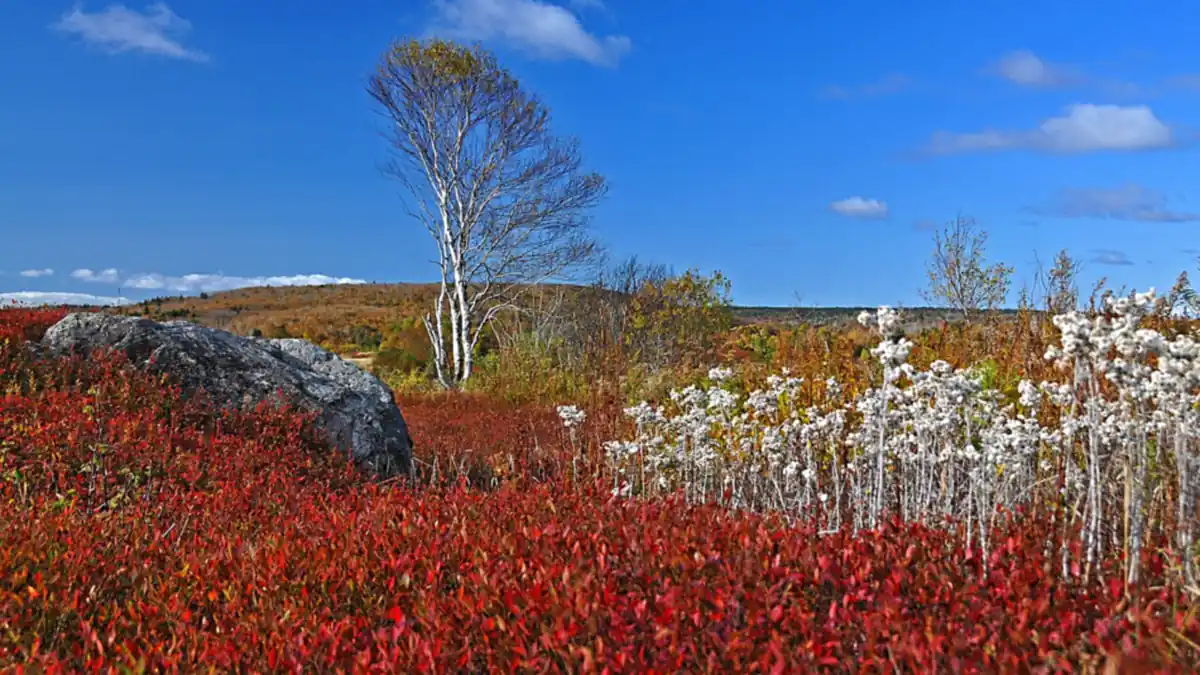
Toombs is studying how plants absorb liquid released overhead by a drone, using wild blueberries as her test crop. The crop is a staple in Nova Scotia but a punishing one to spray from the ground: it spreads through forested areas and abandoned farmland, on soil so sensitive that a traditional sprayer damages the plants every pass it makes.
“In a blueberry field, you’re driving through your crop. And you’re doing this multiple times per season,” Toombs said. Based on preliminary results, she says growers lose “pretty near all of your yield” in the sprayer’s tracks. “If you move the application to aerial, you’re going to keep that yield.”
The stakes are not small. Dalhousie says wild blueberries are the province’s most significant agricultural export — more than 50 million pounds a year from over 40,000 acres and more than 630 growers, worth over $120 million annually in international sales — and the university has built its Atlantic Institute for Digital Agriculture in Truro partly to serve an industry too small and too regional to attract research money from global equipment makers.
The savings case
The team’s pitch is not only about avoiding damage. Hammad Farooq, a Dalhousie PhD student in environmental sciences, uses drones to build prescription maps of fields — detailed images showing exactly which areas need treatment — so farmers can spot-treat instead of blanketing a whole field. “We did four fields recently, and saved around 50 to 60 per cent in fertilizer, as compared to the uniform application,” he said.
The economics matter more than they used to. Statistics Canada recorded an 80 per cent jump in fertilizer prices from 2021 to 2022; prices levelled off in 2024, then started climbing again in 2025 as U.S. tariffs rattled the market. “Our end goal is not to replace farmers’ knowledge, but to support them better,” Farooq said. “If we are using the same traditional methods (to farm) we will not compete in the world.”
Seven labels
For now, the pesticide work is stuck in the research phase because of federal regulation. In Canada, a pesticide can only be applied by drone if its label specifically authorizes use on “remotely piloted aircraft systems.” Most labels say only that a product can be applied aerially — a category written for helicopters and crop-dusting planes — and that is not enough. Health Canada says just seven products on the Canadian market are properly labelled for drone application, and some of those are approved only for industrial use on land without food crops.
Operators also generally need Transport Canada certification and any provincial or territorial certification that applies. Health Canada, which has consulted regulators in the United States and Australia, says it “requires scientific evidence to demonstrate support that spraying pesticides through drones does not pose unacceptable risks to individuals and the environment” — which is why Toombs is logging data on whether drone-sprayed liquid drifts further than spray from a ground rig.
A different rulebook south of the border
Travis Esau, director of the Atlantic Institute for Digital Agriculture, points to the contrast with the United States, where the rules are slightly more relaxed. “In most states, as long as it says on the pesticide label that it’s approved for aerial application, (that pesticide) is grandfathered in for drone use,” he said.
Health Canada says its decisions are made independently, within Canada’s own legislative framework. For the Dalhousie team, that means the path to working drone sprayers in Nova Scotia fields runs through their own data — flight by flight, dye test by dye test.

