

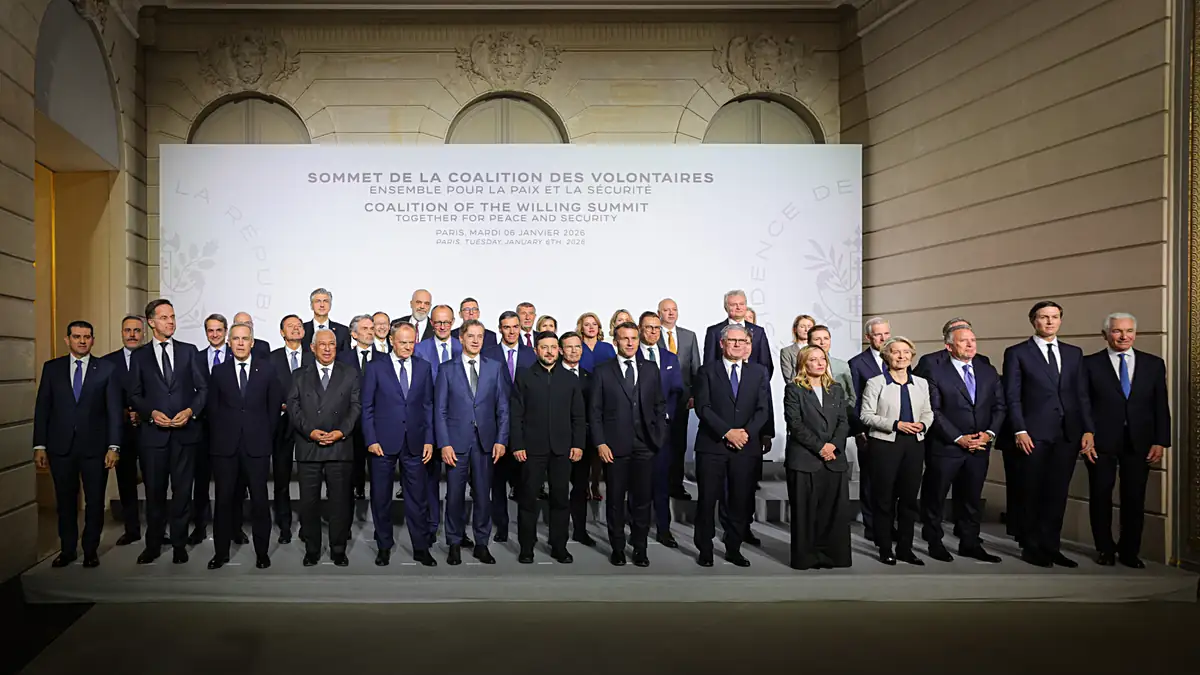
Prime Minister Mark Carney joined allied leaders in Paris on January 6, 2026, as the Coalition of the Willing adopted a declaration on security guarantees for Ukraine. The Paris Declaration promises politically and legally binding guarantees once a ceasefire takes effect, including U.S.-led ceasefire monitoring, long-term military support and a European-led multinational force.
What the Paris Declaration promises
The declaration, agreed by coalition members together with Ukraine and the United States, says any settlement of the war will have to be backed by “robust security guarantees” and confirms that Ukraine’s sovereignty and lasting security will be an integral part of a peace agreement.
The guarantees have five components. Coalition members will take part in a proposed U.S.-led ceasefire monitoring and verification mechanism, with a seat on a special commission that would examine breaches and assign responsibility. They will keep supplying Ukraine’s armed forces — described as the first line of defence and deterrence — with long-term defence packages, financing for weapons purchases, access to defence depots and help building fortifications. A European-led Multinational Force for Ukraine, drawn from willing nations and backed by proposed U.S. support, would help rebuild Ukraine’s forces and deter further attacks once a credible end to hostilities is in place.
Members also agreed to finalise binding commitments to support Ukraine if Russia attacks again, which could include military capabilities, intelligence and logistical help, diplomacy and additional sanctions. Finally, they pledged deeper long-term defence co-operation, including training and joint defence production. A U.S.–Ukraine–coalition coordination cell will be set up at the coalition’s operational headquarters in Paris.
The largest coalition meeting yet
The Paris gathering was the 15th and largest meeting of the coalition, drawing leaders from 27 European countries and Canada, along with senior European Union and NATO officials. In a first, U.S. envoys attended in person: Steve Witkoff, President Donald Trump’s special envoy, and Jared Kushner, the president’s son-in-law. The United States backed the security guarantees at the summit.
France and the United Kingdom went a step further, signing a declaration of intent on deploying their own forces in Ukraine after a ceasefire. British Prime Minister Keir Starmer said the move “paves the way for the legal framework under which British, French and partner forces could operate on Ukrainian soil, securing Ukraine’s skies and seas and regenerating Ukraine’s armed forces for the future.” French President Emmanuel Macron said France could send several thousand troops, while stressing they would monitor and support rather than fight.
Canada’s stake in the talks
Carney travelled to Paris for January 5 and 6 to represent Canada at the table. Announcing the trip, he framed the work plainly: “Canada is working relentlessly with our allies to secure a just and lasting peace for Ukraine. We must deter and fortify – with robust security guarantees and by ensuring Ukraine can rebuild, recover, and create the foundations of true prosperity.”
Ottawa’s contribution so far is financial and material rather than boots on the ground. Since Russia’s full-scale invasion in February 2022, Canada has committed more than $23.5 billion in assistance to Ukraine, including over $12 billion in direct financial support. In December 2025, Canada added a $200 million package of military equipment sourced through NATO’s Prioritised Ukraine Requirements List.
What the declaration does not do is commit Canadian troops. The multinational force is European-led, with non-European coalition members involved but no Canadian deployment announced, and every element of the guarantee system activates only once a ceasefire enters into force. For Canada, Tuesday’s signature is a promise about the peace that might follow the war — and a signal that Ottawa intends to stay in the room while that peace is designed.

