

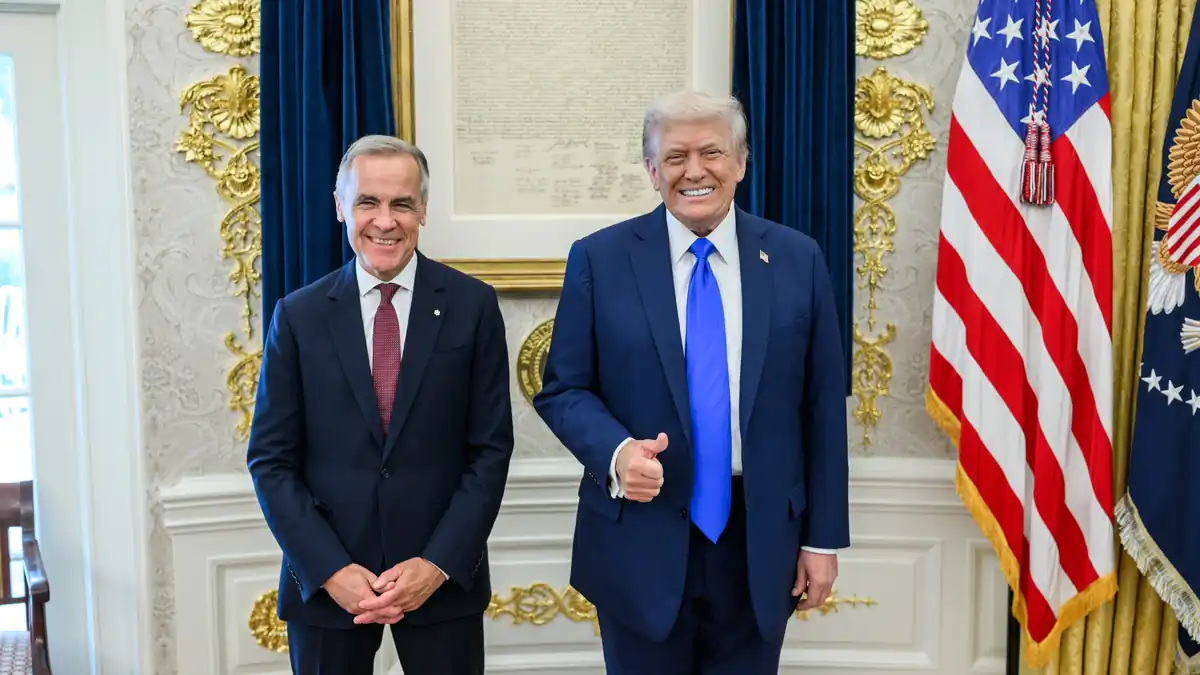
Prime Minister Mark Carney said in Istanbul on Friday, October 23, that Canada has no intention of interfering in the November 3 US midterm elections, rejected American accusations of planned interference as meritless, criticised Ambassador Pete Hoekstra, and said Ottawa is in no rush to sign a trade deal with Washington.
Carney rejects the interference claims in Istanbul
“There is no merit to these claims,” Carney told reporters during the visit to Türkiye. “I’m disappointed their envoy sees that as his role to make these suggestions.”
Carney said Canada had no intention of interfering in the November 3 elections, which will decide control of the US Congress. Asked whether a poor midterm result for President Donald Trump’s Republican Party could prompt Washington to impose fresh tariffs on Canada, Carney said he did not think that was likely.
What the US embassy alleged this week
The US Embassy in Ottawa said on Wednesday that Ottawa “brushes off concerns about potential interference in US elections, even as its ministers and premiers openly describe plans to influence American politics.”
The embassy’s fact sheet centred on the trade dispute. It cited Industry Minister Mélanie Joly’s remarks about using countertariffs to pressure American states, her September meetings with Democratic officials in Boston and Chicago, and an Ontario anti-tariff advertising campaign led by Premier Doug Ford. It also named 11 people charged or sentenced for voting illegally in US elections, without linking those cases to any Canadian government effort.
A week earlier, Hoekstra had told a podcast that his message to Canadians was to “keep your nose out of American politics.”
Canadian officials rejected the suggestion before Carney spoke in Istanbul. Ford said he has “no interest at all” in interfering in American elections. Joly said her work in the United States was diplomacy and investment promotion, and that she had met Democrats and Republicans. Flanked by Joly on Parliament Hill on Wednesday, Carney said: “All of our actions are in the interests of Canadian workers, Canadian families and the future of this economy.”
A trade fight sits underneath the election row
The interference dispute is the political edge of a trade conflict that has run all year. Canada walked away from talks on a possible trade deal in late August, saying the American demands were unreasonable. Those talks had been meant, in part, to reduce some of the tariffs the Trump administration has placed on Canadian goods.
The sequence matters. Washington raised tariffs first, including a 50 per cent duty announced on August 22 on US$27.6 billion worth of Canadian goods, and Ottawa answered with countertariffs of 15, 25 and 50 per cent on an equivalent value of US imports, effective September 8. From Ottawa’s stated position, the countertariffs are a defensive response meant to protect Canadian workers and companies, not a campaign tool aimed at American voters. That is the ground Carney defended on Friday, and the same ground he took in a call with Trump on October 21, when the two leaders discussed trade.
A tariff aimed at products from politically sensitive states is, in trade terms, a way to raise the domestic cost of Washington’s policy. In an election season, the embassy has chosen to read the same measure as an attempt to shape the result.
No rush for a deal, even if it means waiting
Carney repeated that Canada is in no rush to sign a trade agreement, and went further, saying Ottawa could wait beyond the current administration for acceptable terms.
“If it has to be months from now or longer than that, or another administration before a proper deal comes into place, we will do that,” he said.
That patience builds on months of friction in which Carney has pushed back on Trump’s tariff threats while insisting Canada will not become the 51st state. “We will never be the 51st state. We are going our own way,” he said on Friday.
The Türkiye visit is part of the same strategy
Carney made the remarks at the end of the first bilateral visit to Türkiye by a Canadian prime minister. In Ankara, he and President Recep Tayyip Erdoğan launched a Canada-Türkiye Strategic Partnership covering trade, defence, energy and people-to-people ties, backed by a three-year action plan.
The Prime Minister’s Office said the first round of talks toward a comprehensive free trade agreement is set for November 30 to December 4, 2026, in Ankara, with a Canadian trade mission to Türkiye to follow in 2027. Two-way merchandise trade reached $4.3 billion in 2025.
For Ottawa, the visit serves the policy Carney described in the same breath as the election dispute: reducing Canada’s heavy reliance on the US economy by building partnerships elsewhere, so a stalled negotiation with Washington is a problem to manage, not a deadline to meet.

