

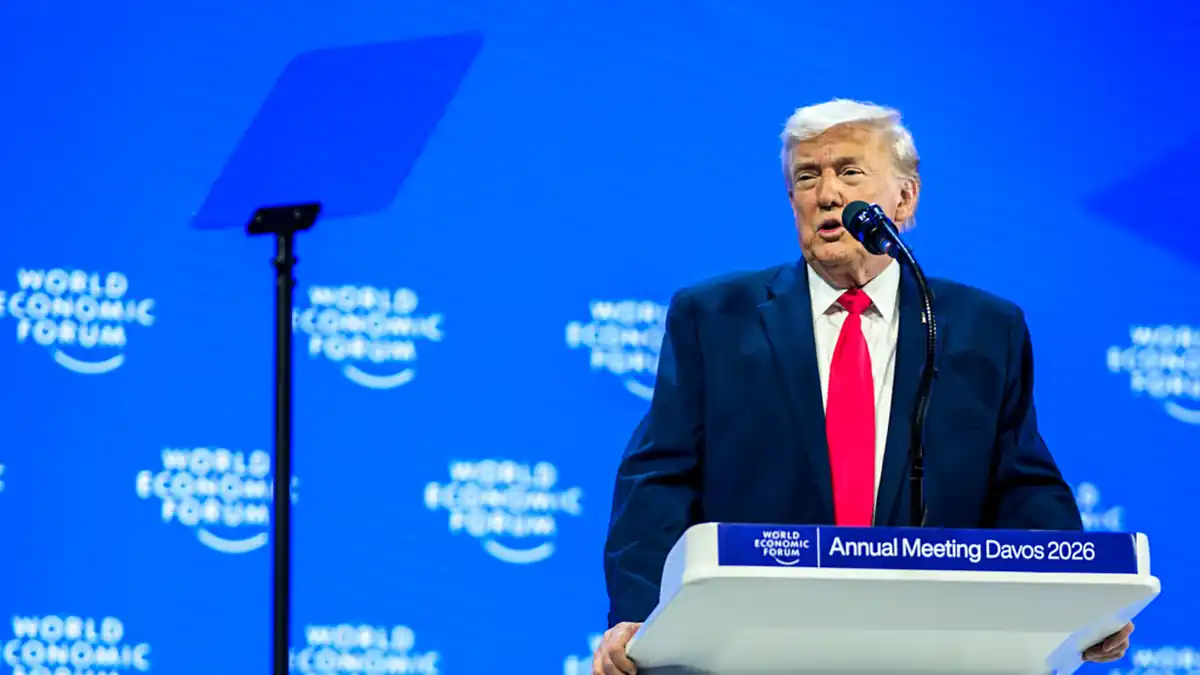
U.S. President Donald Trump threatened on January 24, 2026, to impose a 100 per cent tariff on all Canadian goods if Ottawa went ahead with a trade deal with China. Ottawa responded that Canada is not pursuing a free trade agreement with China, saying the Beijing arrangement only resolved several outstanding tariff issues.
‘China will eat Canada alive’
Trump issued the threat in posts on his Truth Social platform on Saturday, January 24, warning Prime Minister Mark Carney — whom he again addressed as “Governor,” a reference to his suggestion that Canada become the 51st U.S. state — against turning Canada into a conduit for Chinese goods.
“If Governor Carney thinks he is going to make Canada a ‘Drop Off Port’ for China to send goods and products into the United States, he is sorely mistaken,” Trump wrote.
“China will eat Canada alive, completely devour it, including the destruction of their businesses, social fabric, and general way of life,” he added. “If Canada makes a deal with China, it will immediately be hit with a 100% Tariff against all Canadian goods and products coming into the U.S.A.”
A 100 per cent levy on all Canadian goods would be the most severe measure yet in a year-long trade conflict. The United States buys more than 75 per cent of Canada’s exports, so a blanket tariff of that size would hit manufacturers from autos to steel and aluminium especially hard.
What the China deal actually does
The arrangement that provoked the threat was reached during Carney’s visit to Beijing earlier in January, when Canada and China announced a new “strategic partnership” and a set of tariff adjustments. Canada agreed to allow an initial 49,000 Chinese electric vehicles a year into the Canadian market at a most-favoured-nation tariff rate of 6.1 per cent, with the quota set to rise to about 70,000 within five years. In return, China agreed to lower its tariffs on Canadian canola and other agricultural and fish products; Beijing said the tariff on Canadian canola oil would fall from 85 per cent to 15 per cent by March.
The deal unwound part of a 2024 escalation in which Canada, following the United States, imposed a 100 per cent tariff on Chinese electric vehicles and 25 per cent tariffs on Chinese steel and aluminium, and China retaliated against Canadian canola, pork and seafood.
Notably, Trump initially welcomed the Beijing outcome. Speaking to reporters at the White House on January 16, he said: “It’s a good thing for him to sign a trade deal. If you can get a deal with China, you should do that.” His position reversed only after his public clash with Carney at the World Economic Forum in Davos, where Carney warned of a “rupture” in the U.S.-led world order and Trump later revoked Canada’s invitation to his Board of Peace.
Ottawa: no free trade deal is being pursued
Canada’s response came the same day. Dominic LeBlanc, the minister responsible for Canada-U.S. trade, posted on X: “There is no pursuit of a free trade deal with China. What was achieved was resolution on several important tariff issues.” LeBlanc said the government was focused on building a stronger Canadian economy and strengthening trade partnerships around the world.
Carney, in a video message released Saturday, did not mention Trump’s threat directly. Instead he urged Canadians to support domestic producers. “With our economy under threat from abroad, Canadians have made a choice to focus on what we can control,” he said. “We can’t control what other nations do. We can be our own best customers. We’ll buy Canadian.”
On Sunday, Carney made the legal position explicit. He said Canada has no intention of pursuing a free trade agreement with China or any other non-market economy, and noted that the Canada-U.S.-Mexico Agreement requires Ottawa to notify its partners before entering such a deal — a step he said Canada has not taken because no agreement exists. The arrangement with Beijing, he said, “was simply to address some issues that had arisen over the past few years.”
Beijing weighs in
China responded on Monday, January 26. Foreign ministry spokesperson Guo Jiakun said the new strategic partnership between Beijing and Ottawa “does not target any third party,” and the Chinese embassy in Canada told Reuters it was ready to work with Canada to implement the consensus reached by the two countries’ leaders.
U.S. Treasury Secretary Scott Bessent later clarified that the threatened tariff was tied to Canada signing a free trade agreement with China, rather than to the tariff adjustments already announced. Even so, the episode left exporters facing a familiar uncertainty: a threat, delivered by social media post, hanging over the trading relationship while the scheduled review of the continental trade pact approaches this year.

