

U.S. preclearance operations in Canada “remain a critical component” of Washington’s border strategy, the U.S. Embassy in Ottawa says, pushing back on Ambassador Pete Hoekstra’s suggestion the program could be rethought as Canadian travel south drops — and two expansion projects are set to proceed this year.
The embassy pushes back
Canada and the United States say two preclearance projects that would let more travellers be screened well in advance of crossing the border are set to proceed this year, after months of planning and a season of doubt.
The assurances follow comments by U.S. Ambassador Pete Hoekstra that cast doubt on the future of arrangements allowing many passengers flying to American cities to be pre-cleared at Canadian airports by U.S. border officers. Speaking at a conference in Alberta last September, Hoekstra suggested Washington might have to rethink preclearance because of the decline in Canadian travel to the United States prompted by frosty bilateral relations. In a December interview, he insisted sustaining the operations amounts to a “business question” and that his intent was not to be “confrontational.”
Asked about the comments, the U.S. Embassy in Ottawa told The Canadian Press that U.S. Customs and Border Protection “regularly and continuously assesses staffing and resources” to align with mission priorities. Preclearance operations in Canada, it added, “remain a critical component” of the agency’s extended border strategy, designed to enhance national security and streamline travel.
The idea of preclearance is to push the border outward so officials can intercept threats before people or goods cross, Public Safety Canada says. Travellers who clear U.S. inspections in Canada can enter the country or catch a connecting flight far more quickly. The United States runs preclearance at eight major Canadian airports and a ferry terminal in Prince Rupert, B.C. — and the volume is enormous: three out of every five travellers pre-cleared to enter the United States worldwide depart from the Vancouver, Toronto or Montreal airports, and more than 16 million people were pre-cleared from Canada in the 12 months ending Sept. 30, 2024.
Two projects moving
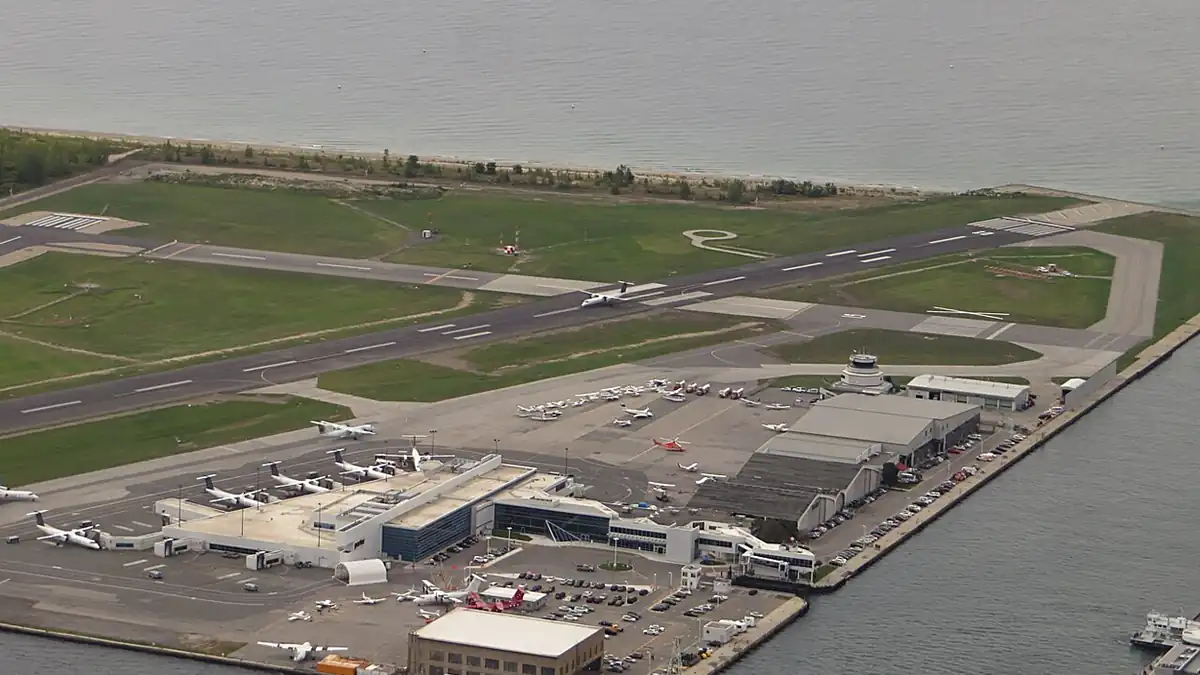
The highest-profile addition is at Billy Bishop Toronto City Airport. The U.S. Embassy said the facility there is complete and final steps are progressing for CBP to begin processing passengers; the Toronto Port Authority said construction wrapped up in late December and the airport is now conducting training and testing, with operations expected by spring. Air Canada has announced plans to expand service from Billy Bishop this year with new daily routes to New York, Boston, Washington and Chicago — largely because of preclearance. The facility did open, on March 10, 2026, making Billy Bishop the ninth Canadian airport with U.S. preclearance.
On the other side of the line, the Canada Border Services Agency is preparing to open Canada’s first preclearance operation in the United States, at Cannon Corners, N.Y., about 80 kilometres south of Montreal on the Quebec border. Announced just over a year ago for a 2025 launch, it is delayed while the agency finalizes policy and procedure revisions and minor infrastructure adjustments. A Canada–U.S. agreement allows preclearance for land, marine and rail travel as well as air, and lets either country operate on the other’s territory. No launch date has been set for Cannon Corners.
Where preclearance could go next
An internal Public Safety briefing note prepared last year, obtained through access-to-information law, listed five locations where preclearance “could realistically be established” within five years: Vancouver’s central rail station, the cruise terminal at Canada Place in Vancouver, the Belleville ferry terminal in Victoria, a possible new rail station in Windsor, Ont., across from Detroit, and the port of entry at Lacolle, Que. Montreal’s central rail station and Quebec City’s airport have also been mentioned as possibilities.
Public Safety told The Canadian Press that “discussions are ongoing” with the United States and transportation partners about expansion — but that there are no immediate plans to establish additional operations.

