

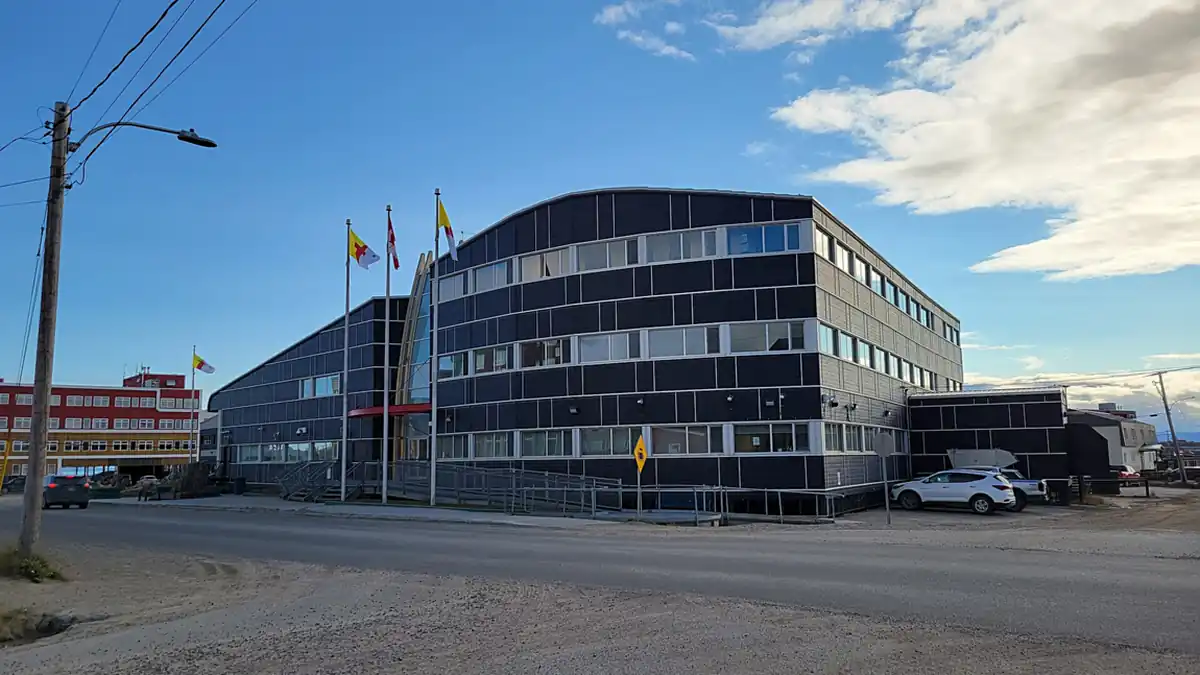
Members of Nunavut’s legislative assembly raised Greenland’s flag outside the legislature in Iqaluit on Tuesday in a show of solidarity with the Inuit-majority island, as U.S. President Donald Trump escalated his threats to annex the Danish territory against its people’s wishes.
A flag, a horn-honking crowd
Speaker David Joanasie said dozens attended the afternoon flag-raising outside the legislature in downtown Iqaluit, including Premier John Main, the representative of the Danish consulate in Iqaluit and Greenlanders living in Nunavut.
“It was a great crowd. People driving by were honking their horns, so it was great to hear,” Joanasie said in an interview.
“With what’s going on across the Arctic, around the world (with) our neighbours in the east, we thought it was very fitting for the legislature to show our support and empathy with the people of Greenland … we are in support of their right to self-determination.”
The gesture followed a weekend of protest. Dozens marched in Iqaluit on Saturday in support of Greenland, holding signs reading “We stand with Greenland” and “Greenland is a partner, not a purchase,” while at the same time large crowds filled the streets of Nuuk, Greenland’s capital, in what police there called the biggest protest they had seen.
Family across the ice
Nunavut’s Inuit have close ties with the Inuit who make up the large majority of Greenland’s population, Joanasie said. People began migrating to Greenland from North America thousands of years ago, including Inuit, and the connections remain personal.
“Nunavut and Greenland have a long history. We have family ties. There’s a cultural connection,” he said. “My colleagues at the legislature have roots. We have a member from Cambridge Bay, his mother is from Greenland.”
Today Greenland has a population of about 57,000, and most estimates suggest roughly 90 per cent of the territory is Inuit. The island is self-governing under Danish sovereignty.
That shared identity is why Trump’s rhetoric has landed so hard across the Canadian Arctic. Sara Olsvig, chair of the Inuit Circumpolar Council, has said the pressure portrays the Arctic “as an asset or as an empty ice desert,” when to Inuit it is a homeland. “The decisions that are made about our land and what we want for it are ours alone,” she said.
Why the threat feels close
Trump escalated his annexation threat in the days before the flag-raising, leaving many of America’s closest allies warning that a takeover would shatter the NATO alliance. Early Tuesday, the president posted an AI-generated photo of himself meeting European leaders in the Oval Office beside a map of the Western Hemisphere, with American flags covering Greenland, Canada, Cuba and Venezuela.
The previous Saturday, he had threatened a 10 per cent import tax on eight European nations refusing to support his planned takeover, rising to 25 per cent in June if no deal was in place. Prime Minister Mark Carney noted the Nunavut legislature’s flag-raising the same day in Davos, where he said Canada stands firmly with Greenland and Denmark.
For the MLAs who raised the flag, the symbolism was the point: a small legislature in Canada’s Arctic answering a superpower’s threats with the flag of its eastern neighbours.

