

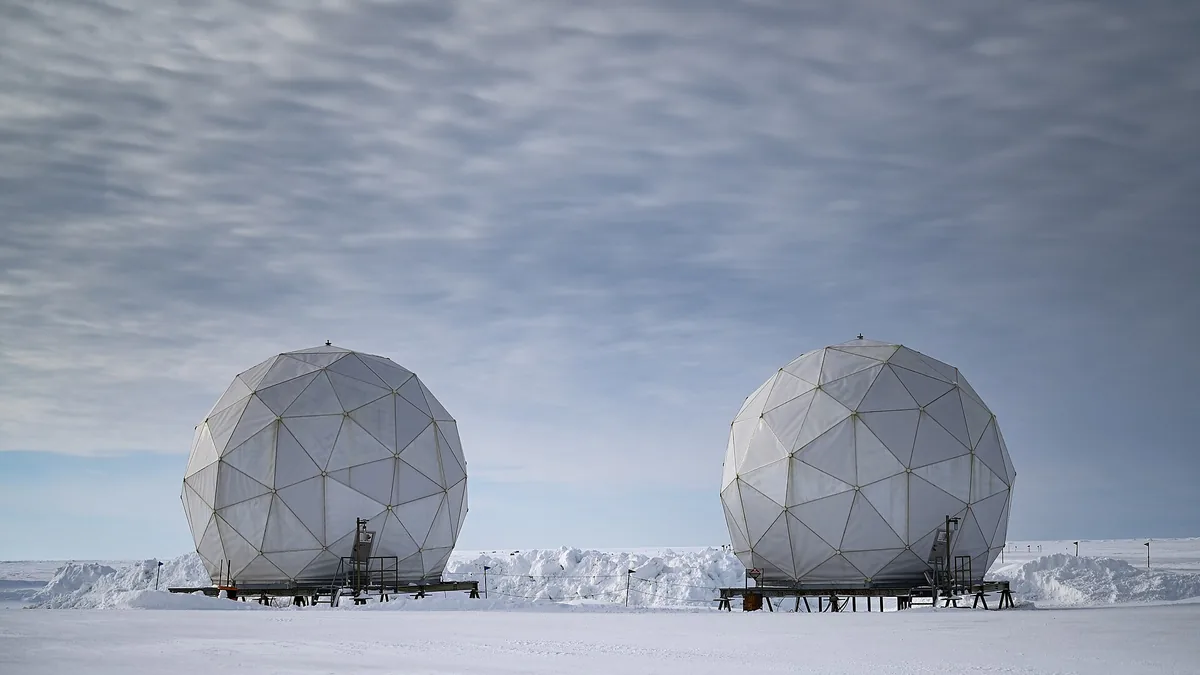
National Defence plans to install 47 Arctic sensor stations across the North starting as early as next summer, according to regulatory filings published in Nunavut. The unstaffed, container-like stations — part of a classified project called Crossbow — would strengthen NORAD’s surveillance and early warning of threats approaching over the Arctic.
47 Arctic sensor stations planned from Yukon to Alert
The planned network would begin in Yukon, near the border with Alaska, and follow the Arctic coastline east across the Northwest Territories, ending at Alert, Nunavut, the most northerly inhabited place in the world. Hercules transport aircraft and Chinook helicopters would airlift the passive sensor installations into place. Each one resembles a large shipping container standing on metal legs. The filings say the sites were picked so the containers can be flown in and set up within a few days, although the exact reasons for choosing each location remain classified.
Solar- and wind-powered stations would stand empty most of the year
The stations are designed to look after themselves. National Defence’s filings describe a defence capability that will operate within “self-powered, autonomous, ruggedized power-generating container systems designed for continuous operations in austere environments and extreme Arctic conditions.” The containers will draw power from the sun and the wind. Apart from the crews who set them up and an annual maintenance visit, the stations will stand unstaffed all year. Two sensor systems are already in place, at Alert and at Sachs Harbour, N.W.T., according to the documents. Lt.-Cmdr. Melanie Aqiqi, a Royal Canadian Air Force spokesperson, said initial deployments could begin as soon as next summer, with an initial operating capability in 2029. Crossbow, she said, is “part of a broader network of capabilities supporting northern air domain awareness.” The filings put completion of the sensor project in 2032, and once fully deployed it is expected to operate for another 20 years.
Some sites sit in a national park and a bird sanctuary
An information package National Defence submitted to the Nunavut Planning Commission calls the project one of “national significance” and says the “proposed sites are required for overall system network operation.” Some of those sites sit in protected areas. The filed plans map two stations inside Quttinirpaaq National Park, on Ellesmere Island, and four inside a migratory bird sanctuary on Banks Island. The documents say the project is expected to have little to no impact on wildlife.
A classified layer in NORAD’s northern rebuild
Crossbow has been public since 2022 but rarely described. Then-defence minister Anita Anand announced it that June as part of the Northern Approaches Surveillance system, the surveillance backbone of Ottawa’s NORAD modernization plan, a package worth $4.9 billion over six years and $38.6 billion over 20 years. Anand said the sensor network would add “another layer of detection” to NORAD. Its companion projects are two over-the-horizon radars — one aimed north from southern Ontario, another planned for the High Arctic — and a future space-based surveillance system. What Crossbow’s sensors actually detect is classified, and the project is being developed with the United States military. It surfaced in Washington in February 2023, when a Pentagon official told a Senate hearing that Crossbow would augment the existing North Warning System, days after a suspected Chinese surveillance balloon crossed North America. That warning line, built in the late 1980s, was not designed to detect the long-range cruise and hypersonic missiles the Defence Department now worries about. The new stations would add a permanent watch to a North where troops already train each winter in exercises such as Operation Nanook-Nunalivut, and where Arctic security has become a political priority — Ottawa opened a consulate in Nuuk this year, and Prime Minister Mark Carney has called Arctic security the answer to the Greenland crisis.

