

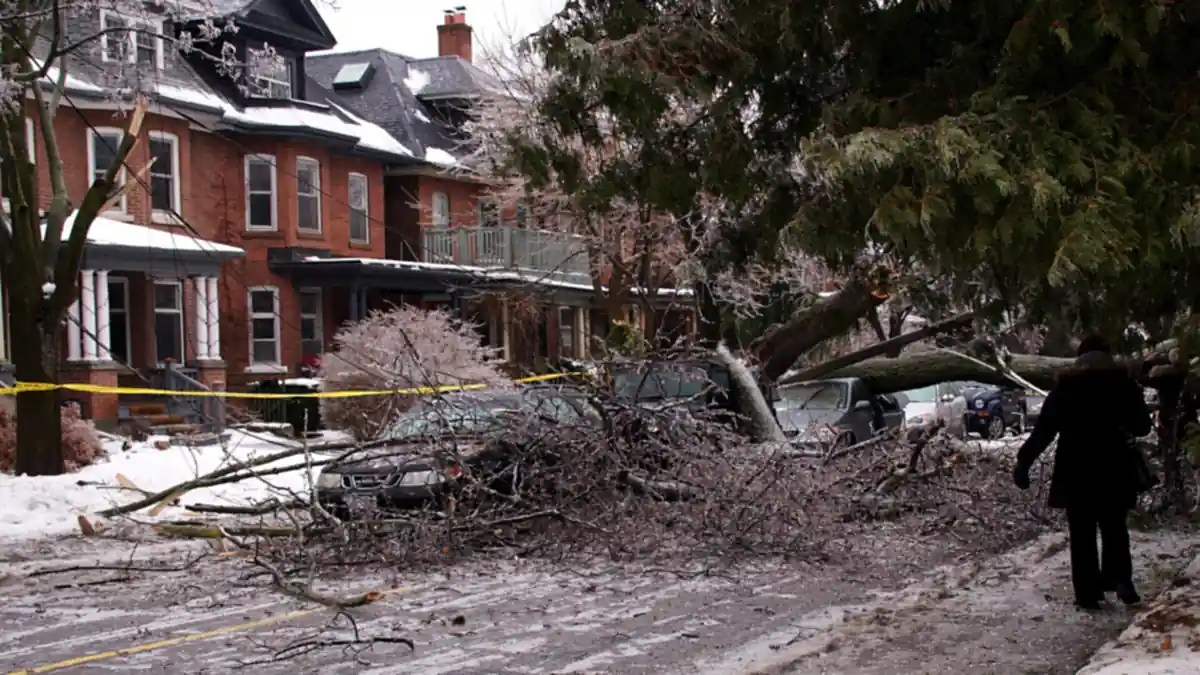
Insured damage from severe weather in Canada exceeded $2.4 billion in 2025, according to Catastrophe Indices and Quantification Inc., making it the tenth-costliest year on record. The late-March ice storm in Ontario and Quebec was the single most expensive event, at $490 million.
The year in five events
The Insurance Bureau of Canada released the annual tally on Tuesday. The largest severe weather events of 2025 were:
- March 28–31: Ontario and Quebec ice storm — $490 million
- May: Flin Flon, Manitoba, and La Ronge, Saskatchewan, wildfires — $300 million
- August: Prairie severe storms, including major hail damage to vehicles in Brooks, Alberta — $235 million
- July: Calgary hailstorm — $160 million
- December: British Columbia atmospheric river floods — $90 million
Together, those five events account for about $1.275 billion — more than half of the year’s total insured losses — spanning ice, fire, hail and flood in a single calendar year.
A billion dollars is the new normal
IBC president and chief executive Celyeste Power said the release should prompt a rethink of how the country builds, plans and restores communities.
“Severe weather events continue to intensify. Two decades ago, insured losses seldom surpassed $500 million in a year. Today, annual costs exceeding $1 billion have become the norm,” Power said. “This shift demands that we fundamentally rethink how we build, plan and restore communities across our country. The best way to keep communities safe and insurance widely available and affordable is to invest seriously in resilience now.”
The decade-over-decade comparison is stark. Canada’s annual insured losses from catastrophic weather and wildfires totalled $14 billion between 2006 and 2015, adjusted for inflation. Between 2016 and 2025, they totalled $37 billion — nearly triple — and the average number of claims has nearly doubled over the same span.
Even so, 2025 sits well below 2024, which remains the costliest year on record, underscoring how volatile the annual totals have become: a single year can now swing by billions depending on where storms and fires happen to land.
The figures are compiled by CatIQ, the industry’s catastrophe-loss database, and cover insured damage only — they do not capture uninsured losses, public infrastructure costs or the economic disruption that follows an evacuation or a flooded downtown. The true cost of 2025’s weather to Canadians was therefore considerably higher than $2.4 billion. Notably, no single 2025 event crossed a billion dollars on its own; the year’s ranking was built from damaging events in every season and nearly every region of the country.
What the bureau wants changed
IBC used the release to press governments to spend on prevention rather than recovery. Its asks include infrastructure that defends against floods, land-use rules that keep homes off flood plains, support for FireSmart programs in high-risk wildfire zones, and the long-delayed building-code changes meant to better protect homes.
“We must stop putting Canadians in harm’s way,” Power said. “As Canada embarks on a historic housing plan, investing in community and household resilience is significantly more cost-effective than paying to rebuild following every disaster.”
The bureau frames the issue as one of affordability as much as safety: as losses mount, insurers price the risk into premiums, and coverage becomes harder to get in the places that need it most — the same places, from Flin Flon to flooded B.C. communities, that dominated the 2025 tally.

