

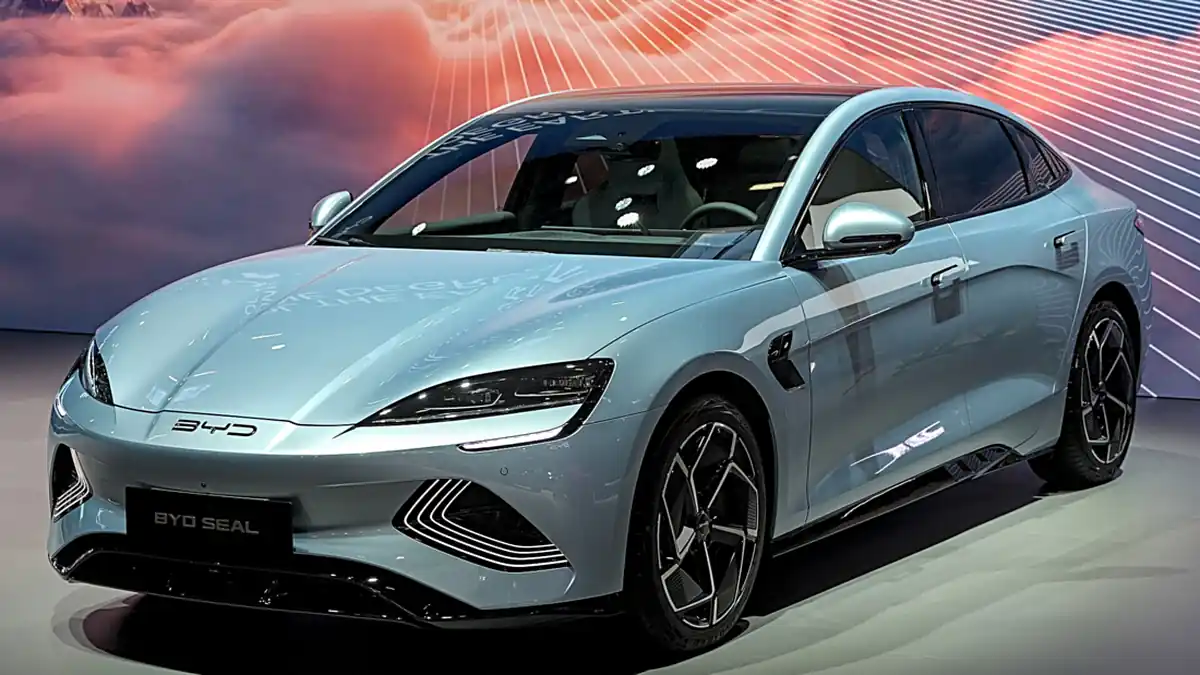
China’s ambassador to Canada, Wang Di, said on Jan. 23, 2026, that the new deal letting up to 49,000 Chinese electric vehicles a year into Canada at a 6.1 per cent tariff is a first step toward Chinese investment, Canadian auto jobs and cheaper cars — answering critics who call it a threat to Ontario’s industry.
‘Only win-win co-operation can last’
As critics attack Ottawa’s agreement to start allowing a small number of Chinese electric vehicles into Canada, China’s envoy says Beijing wants to partner with Canadian autoworkers. “Only win-win co-operation can last,” Wang told The Canadian Press on Wednesday, in remarks published Friday. “All these projects will be beneficial to the development of the Canadian EV industry, and will be helpful for job growth in Canada, and will help Canadian consumers to be able to buy higher quality and more affordable cars,” he said through his interpreter.
Prime Minister Mark Carney and President Xi Jinping signed the agreement last week. It allows Chinese EVs into Canada at a 6.1 per cent tariff rate, with an annual quota of up to 49,000 vehicles and a requirement that half of them carry an import price under $35,000 by 2030. In return, China agreed to ease the agricultural tariffs it imposed after Canada joined the U.S. in 2024 in putting a 100 per cent tariff on Chinese EVs.
Wang suggested Ontario autoworkers have nothing to fear, saying both governments want investments that build up Canada’s manufacturing sector. “The character of China-Canada practical co-operation is complementarity and mutual benefit,” he said. “China encourages and supports Chinese companies to make investments and start up companies here in Canada, on the basis of the market rules. At the same time, we hope that the Canadian side will provide a fair, non-discriminatory and predictable business environment for the Chinese companies that come here.”
A senior Canadian government source who briefed reporters during Carney’s trip said Ottawa does not see the deal as an economic threat, because it fits a larger strategy of eventually building Chinese EVs in Canada. “If Chinese companies will come to Canada to work with Canadian partners for investment, for opening factories or for joint ventures, all of these projects will be win-win,” Wang said. “Unlike some other countries, China will not only take into consideration of its selfish interest. We don’t want ‘only we win and others lose.'”
Ford and Unifor are not persuaded
Ontario Premier Doug Ford has called the agreement a “lopsided deal” that risks flooding the market with cheap EVs, with no guarantee of Chinese investment and with the threat of limiting Canadian automakers’ access to the critical U.S. market. Unifor president Lana Payne called the deal a “self-inflicted wound” and warned China will quickly seize market share, as it has in other markets.
Analysts critical of China’s industrial policy warn its subsidies have created a glut of cheap cars that could artificially depress prices and deepen deindustrialization. Margaret McCuaig-Johnston of the China Strategic Risks Institute has also raised the threat of surveillance from software in Chinese EVs, which links to mobile networks and often to the driver’s personal phone.
The Magna precedent
At an Institute for Peace and Diplomacy panel on Thursday, Wenran Jiang, head of the Canada-China Energy and Environment Forum, pointed to a working model: Canadian auto-parts giant Magna International, headquartered in Aurora, Ont., has a deal with a Chinese automaker to build cars in Austria, blending Chinese know-how with local labour. “If they can do that, we can do it certainly here in Ontario,” Jiang said, arguing that is how Canada avoids regional splits over engagement with China. “We could do probably better if we leverage our regional advantages and work together as a team.”
The pitch formed part of a two-pronged message from the ambassador this week. In the same round of interviews, Wang urged Ottawa to move quickly to implement the Beijing agreements before Carney’s planned return to China for November’s APEC summit — framing the EV opening not as an endpoint, but as the first instalment in a broader economic package whose value to Canada depends on investment that has yet to be announced.

