

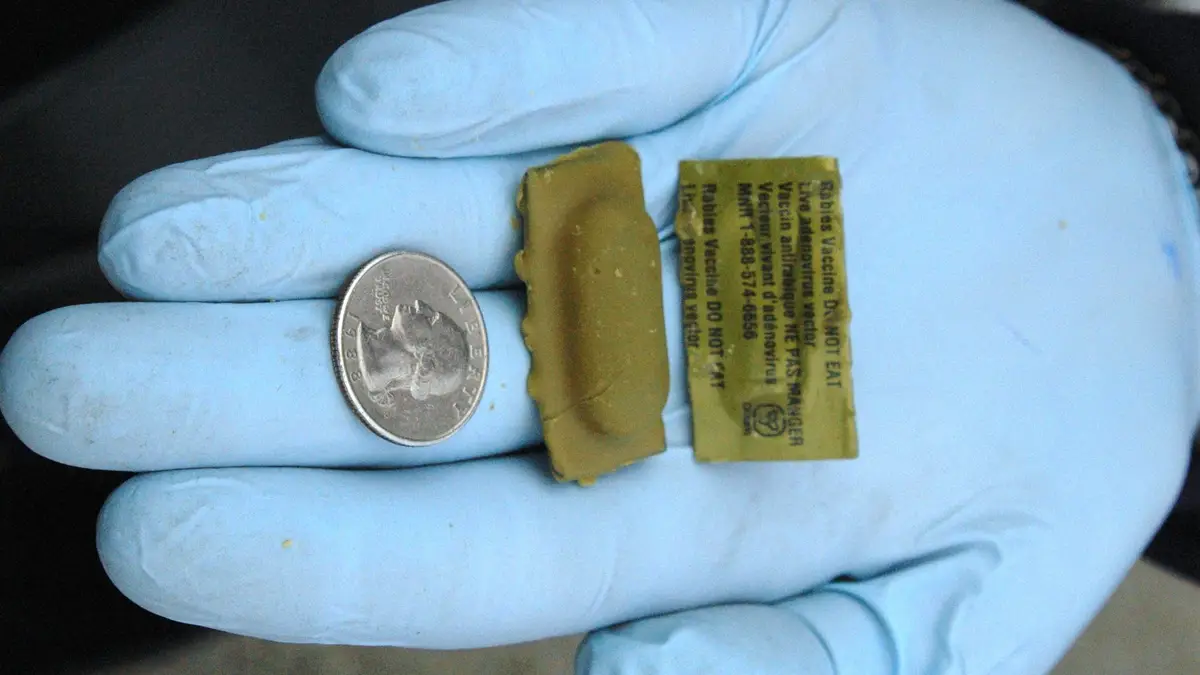
After nearly a decade away, raccoon rabies in Quebec has returned, and provincial teams are vaccinating wild animals by the hundreds of thousands to keep the virus from reaching Montreal. The province counts 313 confirmed cases in 2026, most in Montérégie. Here is how the disease spreads, what officials are doing, and what residents should do.
How raccoon rabies in Quebec came back
Rabies is a viral disease that attacks the nervous system of mammals, including humans, and is usually transmitted when infected saliva gets into a wound or a mucous membrane, according to the Quebec government’s rabies page. Once symptoms appear, the disease cannot be cured and death is inevitable.
The raccoon variant circulates mainly in raccoons and striped skunks. It was found in southern Quebec between 2006 and 2009, likely arriving from Vermont, and control operations eliminated it; a single case was detected in 2015. The Canadian Wildlife Health Cooperative (CWHC) reports that the virus resurfaced in December 2024 near Saint-Armand, after cases had been multiplying in Vermont since 2022. A second, smaller outbreak has been developing around Stanstead, south of Sherbrooke, since August 2025, the CWHC says. From Saint-Armand, the main outbreak has moved north toward Bromont and Mont-Saint-Hilaire, and since January 2026 Montérégie has been its epicentre.
An infected animal may be disoriented, show no fear of humans, or display unusual aggression, prostration or progressive paralysis, according to the CWHC. A raccoon or skunk active in broad daylight in an urban area, or one that does not flee, should raise suspicion.
Vaccinating wildlife with baits, planes and traps
The province’s main tool is the vaccine bait: a small packet with a sweet coating that immunizes a raccoon, skunk or fox that bites into it. The environment ministry’s surveillance page says a manual distribution from Aug. 3 to Sept. 13, 2026 spread more than 815,000 baits across nearly 5,500 square kilometres and 114 municipalities in Estrie, Montérégie and Centre-du-Québec, including Montreal-area parks. An aerial drop followed from Sept. 19 to 23, with low-flying planes scattering about 440,000 baits over some 3,200 square kilometres of forest and field edges in 62 municipalities.
Because cases have risen significantly in Montérégie since March 2026, threatening the South Shore and the Island of Montreal, the ministry added a trap-vaccinate-release operation that ran from Oct. 13 to 23, 2026. Over roughly 40 square kilometres in Brossard, Longueuil, Sainte-Catherine, Saint-Constant and Saint-Lambert, wildlife technicians and animal health professionals caught raccoons and skunks in cages, vaccinated them by hand and released them where they were found, marked with an ear tag and fading paint. The cages are checked daily, the ministry says, and any pet or unintended species caught is released. Residents in the area were asked to keep domestic animals indoors or supervised and never to approach a cage or try to free a captured animal.
What the case numbers show
The provincial government’s published case list counts 313 confirmed cases of raccoon rabies since Jan. 1, 2026. The CWHC counted 159 confirmed cases from December 2024 to early June 2026 — 93 of them in 2025 — before Montérégie took over as the centre of the outbreak this year. The province’s list also records the virus reaching a domestic animal: a cat in Saint-Denis-sur-Richelieu tested positive for the raccoon variant on Sept. 25, 2026. Testing is the backbone of the response: the CWHC’s Quebec centre analyzes raccoons, skunks, foxes and coyotes found dead or sick in the surveillance zone, and says it has run about 17,000 rabies tests since 2010.
What to do after a bite, scratch or close encounter
If an animal bites or scratches you, wash the wound thoroughly with soap and water for at least 10 minutes, then call Info-Santé at 811 for a medical evaluation, the CWHC advises. Post-exposure preventive treatment is highly effective when given promptly, so do not delay, even if the injury looks minor. A wild animal you suspect has rabies should be reported to the province at 1-877-346-6763 so it can be collected for testing.
Pet owners should keep rabies vaccinations up to date and not let animals roam unsupervised, according to the CWHC. It also recommends garbage cans with locking lids and never leaving pet food outdoors. The province prohibits moving live raccoons, skunks, foxes or coyotes out of municipalities near known cases, since a relocated animal can carry the virus to a new area.
The ministry says control operations will have to continue over the next few years to slow the disease and eventually eliminate it. The CWHC notes there is a precedent: a large vaccination campaign in the early 2000s eradicated raccoon rabies from Quebec once before.

