

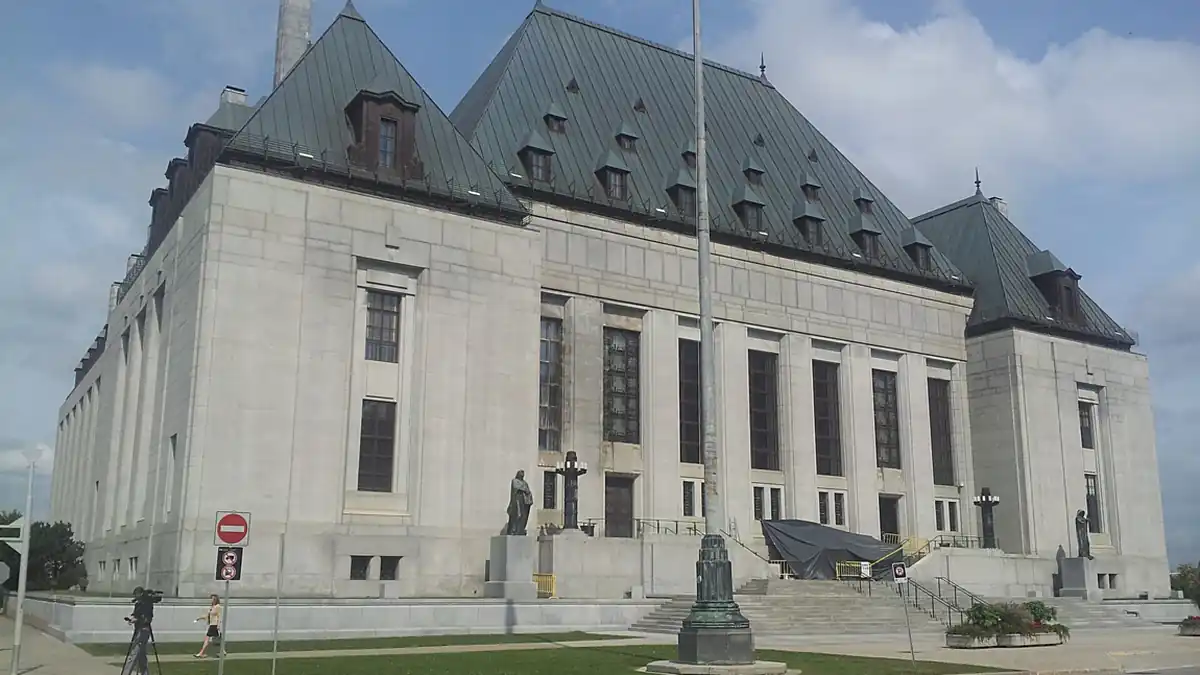
Lawyers for the attorneys general of Canada and several provinces asked the Supreme Court of Canada to uphold Quebec’s law allowing police to stop drivers at random without cause, while civil rights groups argued the power predictably produces racial profiling and should not survive.
Day two: the interveners
The country’s top court spent a second morning on Tuesday hearing arguments over whether it is constitutional for police to make traffic stops without reasonable suspicion that a driver has committed an offence.
Tuesday’s session heard from interveners — interested parties on both sides. Civil rights groups and organizations representing Black and Indigenous communities argued the stop power should fall. Groups representing police chiefs and Mothers Against Drunk Driving argued spot checks are among the most effective tools to deter and detect impaired, unlicensed and uninsured driving, and vehicles that are unsafe.
Federal Justice Department lawyer Marc Ribeiro told the court police need discretionary stop power to fight impaired driving. He offered the example of an officer who sees a group of people leaving a house party late at night and pulls them over — a situation that would not amount to reasonable suspicion, and would not be covered by a structured checkpoint, neither of which is being challenged in the case.
“We could move on to a multitude of other examples where a police officer must act quickly based on what they observe in real time without otherwise observing erratic driving or forming a reasonable suspicion of it,” he said.
The attorneys general of Ontario, British Columbia, Saskatchewan and Alberta joined Quebec and Ottawa in arguing that profiling is real and insidious, but can be fought in other ways — through data collection by police forces, easier recourse for victims, or court declarations — without removing the stop power itself.
The driver at the centre of the case
The case belongs to Joseph-Christopher Luamba, a Black Montrealer of Haitian descent who says he was stopped nearly a dozen times in the 18 months after he got his driver’s licence in 2019, while driving or riding in cars. None of the stops resulted in a ticket.
Fernando Belton, a criminal lawyer at a Montreal legal clinic, told the court the 1990 precedent behind the practice predates modern research on racial profiling, and its conclusions “no longer hold.” Upholding the law, he said, “would amount to authorizing the continued violation of the fundamental rights of Black communities, but this time … they would act with full knowledge of the devastating causes and consequences of racial profiling.”
Sabrina Shillingford of the Black Legal Action Centre made the evidentiary argument: “The evidence tells us that the law predictably produces discriminatory effects for Black drivers and therefore cannot be upheld.”
Much of the hearing turned on exactly that question — whether profiling is an “inevitable consequence” of the law, which is central to the constitutional analysis.
A 36-year-old precedent
Luamba’s challenge has already won twice. Quebec Superior Court Justice Michel Yergeau declared the random-stop provision of Quebec’s Highway Safety Code inoperative in 2022, finding that racial profiling exists and weighs heavily on Black people. The Quebec Court of Appeal upheld the ruling in 2024, and Quebec appealed to the Supreme Court.
The decisions broke with R. v. Ladouceur, the Supreme Court’s 1990 ruling — decided 5-4 — that random stops are a justified infringement because they are the only way to check whether drivers are licensed, vehicles are mechanically sound and drivers are sober. Because stop powers exist in law across Canada, whatever the court decides will be felt far beyond Quebec.
The judges reserved their decision and gave no indication of when a ruling will come.

