

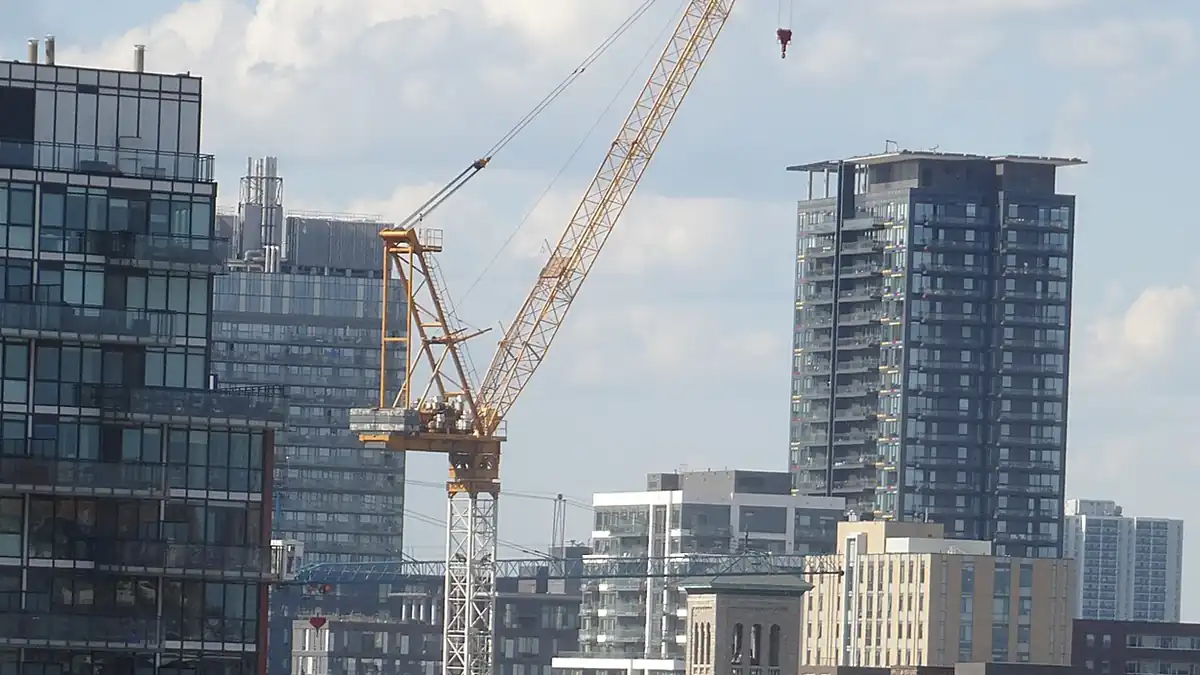
The total value of building permits issued in Canada fell $1.8 billion, or 13.1 per cent, to $12.0 billion in November 2025, Statistics Canada reported on January 13, 2026. Residential intentions fell $1.0 billion and non-residential intentions fell $788.2 million. Ontario’s multi-family component led the residential decline after leading gains in October.
A sharp monthly reversal
Canada’s construction intentions dropped sharply in November, giving back much of the previous month’s momentum in a single release.
Statistics Canada said the total value of building permits issued across the country decreased by $1.8 billion, down 13.1 per cent, to $12.0 billion. Both main sectors moved in the same direction: residential intentions fell by $1.0 billion, and non-residential intentions fell by $788.2 million.
Measured in constant dollars, with 2023 as the base year, the picture was almost identical. The total value of permits declined 13.3 per cent from October, and was down 3.9 per cent compared with November a year earlier.
Building permits are not construction itself. They are the municipal authorizations that precede it, which is why economists read them as an early signal of what builders intend to put in the ground in the months ahead. A one-month fall does not set a trend, but a fall of this size, spread across both sectors, is difficult to dismiss.
Ontario multi-family projects led housing down
Residential construction intentions decreased by $1.0 billion, down 12.0 per cent, to $7.5 billion in November. Ontario drove the decrease, falling $884.5 million, after the province had led the sector’s gains in October.
The engine of the decline was the multi-family component — apartment and other multi-unit buildings. It fell $1.0 billion nationally to $4.9 billion. Ontario accounted for a $928.1 million drop in that component, followed by Quebec at $263.8 million. British Columbia moved the other way, adding $196.9 million and tempering the national decline.
Single-family intentions, by contrast, were nearly flat. They edged down just $3.8 million to $2.6 billion. Gains in seven provinces and one territory were almost fully offset by a decline in Quebec, where single-family intentions fell $80.5 million.
In unit terms, municipalities authorized 20,500 multi-family dwellings and 4,100 single-family dwellings in November. Total residential authorizations were down 11.4 per cent from the previous month.
Non-residential intentions fell across the board
The non-residential sector fell $788.2 million to $4.5 billion, a drop of about 14.9 per cent from October. Unlike housing, where one component carried the decline, the non-residential weakness was broad.
Trade coverage of the release noted losses across the commercial, institutional and industrial components, with Ontario, and the Toronto area in particular, leading the commercial decline. Commercial permit values fell in six provinces and two territories.
For the federal government, that breadth matters. Ottawa’s housing debate usually centres on homes, but permits for factories, offices, shops, schools and hospitals are also a measure of business and public-sector willingness to commit capital. November showed hesitation on both sides of the ledger at once.
The longer view is less bleak
The same release that recorded the November drop also contained the figures that keep it in perspective. From December 2024 to November 2025, municipalities authorized 259,300 multi-family dwellings across Canada. In the previous 12-month period, the figure was 224,700.
That is a substantial increase in the pipeline of multi-unit housing, the segment most closely tied to rental apartments and condominiums in large cities. November’s fall came after a strong October, led by Ontario. Permit values for large multi-family projects are lumpy: one month can contain several major approvals, and the next can look weak by comparison without any change in demand.
Statistics Canada’s constant-dollar comparison makes the same point in a different way. Permits were down 3.9 per cent from a year earlier, a real decline, but far smaller than the 13.1 per cent monthly swing in current dollars.
What to watch next
The November release, published on January 13, 2026, will be judged by what followed it. If December and the early months of 2026 return to October’s level, November will read as a pause after an unusually strong month, concentrated in Ontario multi-family projects.
If the lower level holds, the implications run in two directions. For housing, fewer multi-family authorizations today mean fewer apartment completions competing for tenants two to three years from now, in a market where the federal government has made multi-unit supply a central policy goal. For the wider economy, continued weakness in commercial, industrial and institutional permits would point to cautious investment well beyond the housing sector.
For now, the record is a steep, broad, one-month decline — sharp enough to notice, and, on the release’s own 12-month figures, not yet enough to reverse a record year for multi-family authorizations.

