

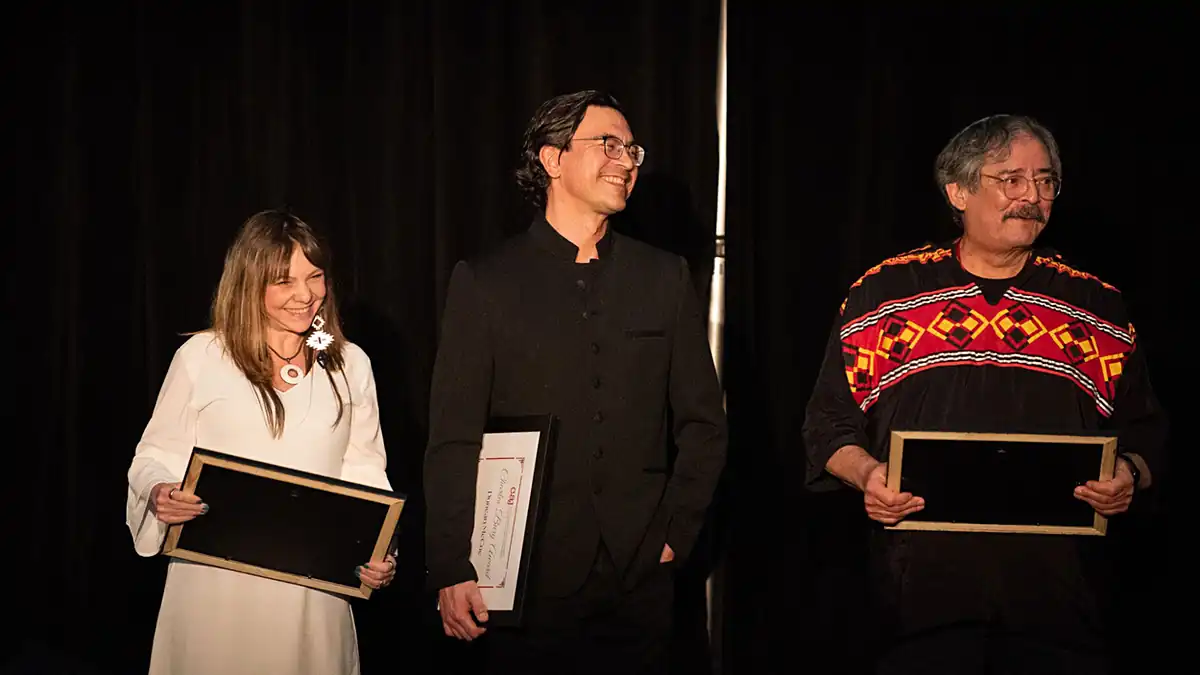
Dan David, the Mohawk journalist from Kanesatake, Que., who co-founded the Aboriginal Peoples Television Network’s news department and mentored dozens of Indigenous reporters, has died at 73. His sister Marie David said he died Jan. 12, 2026, after a long struggle with cancer.
“He was Indigenous journalism in this country”
Colleagues remember David as the founding force behind APTN News, which he helped launch in 2000 under the name InVision News. APTN was the world’s first national Indigenous television network, and David, its first news director, built its newsroom with a simple conviction: Indigenous stories should be told by Indigenous journalists.
“We call him the father of APTN News,” said Karyn Pugliese, an APTN host and producer who was part of that first newsroom. “He was an icon. Dan David was Indigenous journalism in this country … he made a lot of people really think about journalism.” Pugliese said APTN’s reporting showed people in one community that they were not alone — that a problem they thought was only theirs was shared across the country.
Jim Compton, APTN’s program director at launch, recalled the two of them asking each other every morning, “Wonder what fresh hell awaits us today?” — and living, he said, “the dream of creating a national network with a flagship news department covering news from coast to coast.”
Kanesatake, and being pulled off his own story
David’s determination to change how Indigenous stories are told was forged during the Oka Crisis of 1990, the 78-day standoff between Mohawk land protectors, Quebec police, the RCMP and the army over a golf course expansion and other development on disputed land in his home community of Kanesatake.
David was reporting for CBC at the time. Despite his sources and family connections — some of his relatives were among the land protectors — he was pulled away from the coverage because he was considered biased. Retired CBC journalist Loreen Pindera said it irked David that mainstream coverage fed stereotypes of Indigenous people as dangerous while ignoring the activists’ cause.
Soon after, his CBC mentor asked him to help launch the South African Broadcasting Corporation in post-apartheid South Africa. Working alongside journalists who had been on opposite sides of the apartheid years shaped the approach he later brought home. “He would talk about that experience for years afterwards as he was training us at APTN,” Pugliese said. “He believed that journalism was for the people.”
A teacher with a sense of humour
Across a career of nearly five decades, including work with CBC, TVOntario and VISION TV, David also served as chair of diversity at Toronto Metropolitan University and taught at the University of Toronto. Colleagues describe a demanding but empathetic newsroom leader who listened to everyone and, as Pugliese put it, was “proud without thinking too highly of himself.”
He was also funny. Invited to a conference, he once registered himself not as an “elder” but as an “old fart.” In his final years, he cycled to raise money for cancer research.
David was the third oldest of eight siblings. “Since his passing, many people have reached out to us,” his sister Marie said. “They said how much they’re going to miss him and how much he gave to them just by teaching them.”

