

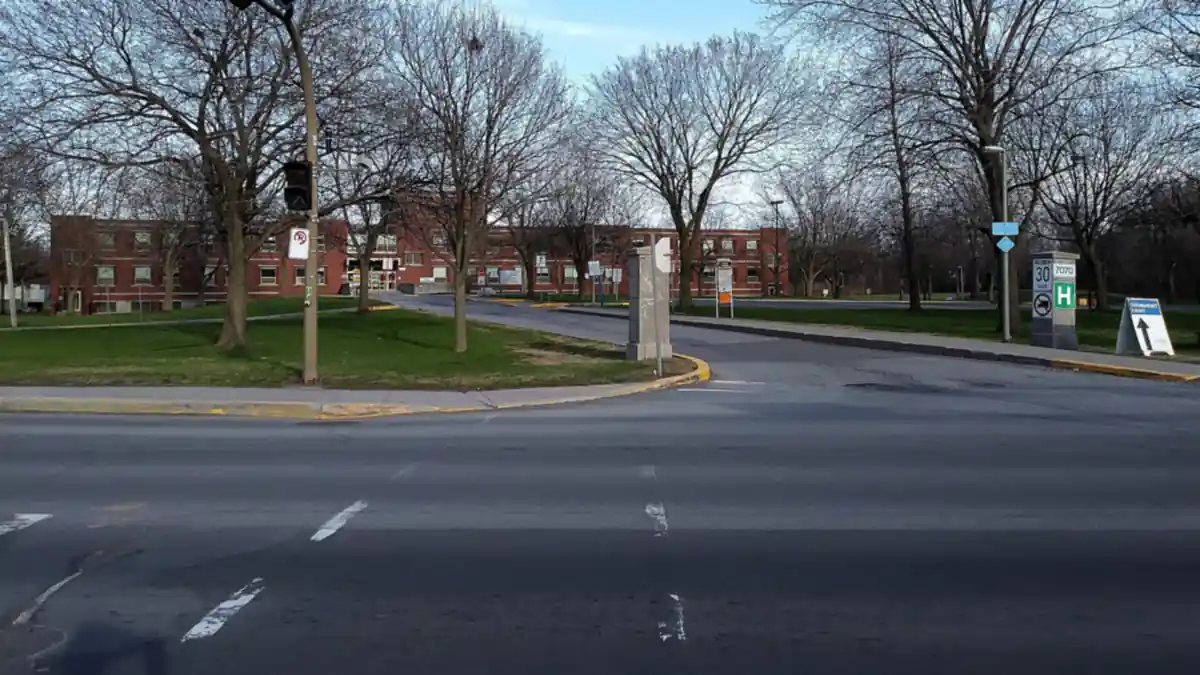
Burst pipes at Montreal’s Douglas Mental Health University Institute flooded four research laboratories on Monday, damaging sophisticated equipment used in Alzheimer’s and depression research. The local health authority blamed cold weather and the aging Lehmann pavilion, built between 1894 and 1910, and said nobody was injured in the flooding.
Water through the ceiling
Video of the incident shows water raining down onto equipment in one of the labs as a waterlogged ceiling tile gives way and crashes to the floor. The local health authority, the CIUSSS de l’Ouest-de-l’Île-de-Montréal, said the incident was major and damaged the second and ground floors of the Lehmann pavilion.
“The Douglas Mental Health University Institute confirms that significant water damage occurred in four different locations in a corridor on the second floor of the Lehmann pavilion,” spokesperson Hélène Bergeron-Gamache wrote in an email. She said the recent cold weather and the “aging infrastructure of the Douglas Institute” were likely at the root of the problem. Nobody was injured, but water also had to be cut to several neighbouring buildings, and teams were on site to repair the damage and limit disruption to research.
Sylvain Williams, a neuroscientist at the Douglas, said he believed the flooding was caused by broken piping related to the sprinkler system. The labs house research largely focused on Alzheimer’s disease and depression.
“Many of the labs have very sophisticated equipment, I would say, (worth) several hundreds of thousands (of dollars) or up to $2 million of instruments could have been damaged here,” he said in an interview. “So we’re still assessing the damage, but it’s certainly going to be very expensive.”
‘I was expecting that something like this would happen’
Williams, who has worked at the Lehmann Centre for about 30 years, described the flood as shocking but not surprising. The building has had recurring problems in recent years, including a fire in an electrical box and leaking ceilings.
“This building should have been demolished years ago,” he said later. “Unfortunately, it has not because there were no other alternatives. We have been asking for a new building, a new hospital. But nothing has moved forward.”
Researcher Mark Brandon said it took him a decade to build his laboratory, which was completely destroyed. “It’s not just a financial value. A lot of time went into this creatively, building up that lab space, so it’s devastating,” he said. Follow-up reporting put the number of research projects halted by the damage at about 100.
Staff have long called on the provincial government to fund a new hospital and research centre. Verdun MNA Alejandra Zaga Mendez of Québec solidaire, who has gathered about 600 signatures on a petition to renovate the facility, said more than 65 per cent of the buildings on the campus are in poor or very poor condition, and noted that a multimillion-dollar modernization plan announced during the Coalition Avenir Québec’s first mandate was later shelved.
The province responds
Health Minister Sonia Bélanger said through a spokesperson that the images of the damage were “deplorable.” “We do not wish to see this in our health facilities,” she said. Bélanger said significant investments have been made to update health facilities in recent years, including an additional $435 million added in the last year through Quebec’s infrastructure plan. The email did not specify whether any major investment is planned for the Douglas.
In the aftermath, the Douglas Hospital Foundation appealed directly to donors for $1 million to help cover the damage, after asbestos contamination was found during the cleanup — a measure of how far the institute had to go to pay for a failure its staff say they saw coming.

