

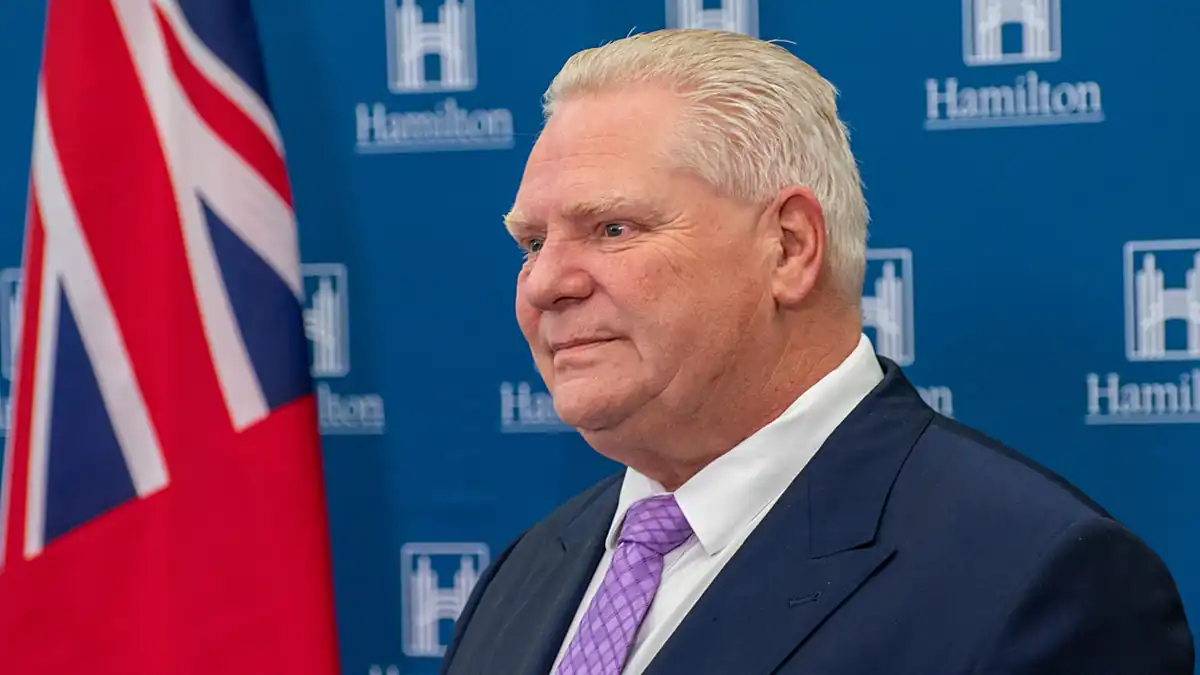
Ontario Premier Doug Ford called on Canadians on Wednesday, January 21, 2026, to boycott Chinese-made electric vehicles that will be allowed into Canada under Prime Minister Mark Carney’s trade deal with Beijing. Flanked by auto industry executives and Unifor’s national president, Ford said the deal puts Ontario auto jobs at risk.
‘Boycott the Chinese EV vehicles’
“Boycott the Chinese EV vehicles. Support companies that are building vehicles here,” Ford said at a Queen’s Park press conference. “This is a team Canada approach. We gotta stick together.”
“Maybe a few people might buy them, and I discourage anyone from buying a Chinese vehicle,” he said. “But if they decide to do that, at what cost is it? Is it at the cost of your neighbour down the street that’s working in the auto sector that he’s not going to have, or she’s not going to have a job?”
Ford has been critical of the deal since it was announced the previous Friday, calling it “lopsided” in a post on X and warning that “China now has a foothold in the Canadian market and will use it to their full advantage at the expense of Canadian workers.” He repeated his complaint that Carney did not speak to him about the agreement in advance, and said the two men had not spoken since.
Industry and union leaders back the call
Ford was joined by Brian Kingston, president and CEO of the Canadian Vehicle Manufacturers’ Association, Flavio Volpe, president of the Automotive Parts Manufacturers’ Association, and Lana Payne, the national president of Unifor — an unusual show of unity.
“There’s no sugar-coating this. We are in the fight of our lives here fending off Trump’s tariffs, and that fight just got a little harder,” Payne said. She said nearly 4,000 Unifor members were without work, with 1,000 more expected to be affected by the elimination of a shift at General Motors in Oshawa.
Volpe noted that 50,000 vehicles represents a shift at an auto plant, saying “those jobs don’t exist comfortably in this new world.” Kingston said there is “no industry without U.S. access and North American integration,” and dismissed diversification into European or Asian markets as an option for Canadian assembly plants.
The group called on Ottawa to step up with measures to boost the domestic industry’s competitiveness — lowering the cost of investing in plants, machinery and research and development — and to scrap the federal EV sales mandate, currently paused, along with federal fees that add to vehicle costs.
Ford rejects the assembly argument
Carney has suggested Chinese automakers could one day produce vehicles in Canada. Ford said he did not believe that would ever happen, and dismissed the idea even as a hypothetical.
Asked whether he could support Chinese vehicles being manufactured in Canada, Ford said “the numbers just don’t add up.” “Even if they do start assembling, how about the supply chain? They come and they assemble, but they bring all Chinese parts in; that means nothing,” he said. “We want to make sure we produce Canadian cars by Canadians, with the R and D and the specs and everything, and the steel, and the aluminum from Canada. It’s as simple as that.”
Payne made a similar point: given China’s “massive over-capacity in EV production,” she argued, Chinese companies have little reason to establish meaningful manufacturing operations in Canada.
Ford said he would sit down with Carney and the other premiers the following week before deciding on any Ontario response. “I want to find out what is the big auto deal that they have here for Ontario to protect auto workers… I’ll see what they have to say, then we’ll respond appropriately,” he said.
A small quota with big politics
The fight is over a limited opening. The deal allows up to 49,000 Chinese-made EVs into Canada each year at a 6.1 per cent tariff, down from the 100 per cent surtax imposed in 2024 — a figure Carney has noted is about three per cent of the roughly two million vehicles sold in Canada annually. BMO economist Erik Johnson offered a similar estimate.
The other side of the bargain lands far from Ontario’s assembly plants: Beijing agreed to cut its tariffs on Canadian canola seed to 15 per cent from 84 per cent by March 1, a major relief for Prairie farmers. Federal Conservative labour critic Kyle Seeback questioned the trade-off, asking how Canada ended up choosing “between benefiting Canadian canola farmers and punishing Canadian auto workers.”
Ontario Green Leader Mike Schreiner took a different line, arguing the province should respond with its own EV strategy — incentives to create demand for Ontario-made vehicles, rebates and charging investment — rather than relying on a boycott call.

