

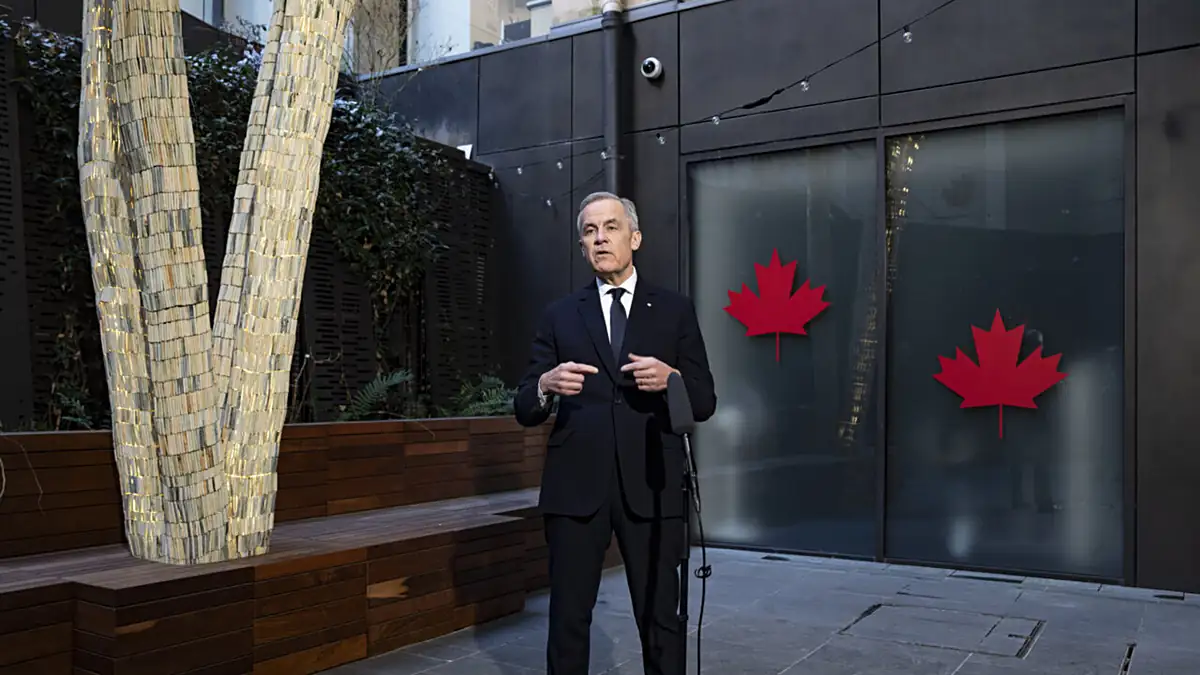
Prime Minister Mark Carney told Danish Prime Minister Mette Frederiksen in Paris on January 6, 2026, that Canada supports the sovereignty and territorial integrity of Denmark, including Greenland. Carney said Greenland’s future is for Greenlanders and Denmark to decide, as U.S. President Donald Trump renewed talk of annexing the island.
Support delivered in person in Paris
Carney met Frederiksen at the Canadian embassy in Paris on Tuesday, on the margins of the Coalition of the Willing meeting on Ukraine. According to the readout from the Prime Minister’s Office, Carney “emphasised Canada’s support for the sovereignty and territorial integrity of Denmark, including Greenland, which must be respected in accordance with international law,” and affirmed Canada’s support for a joint statement on Greenland issued that day by Denmark and European leaders.
Speaking to reporters earlier, Carney was blunt about who decides the island’s status. “The future of Greenland is a decision exclusively for the people of Greenland and Denmark,” he said. He also pointed to the alliance both countries belong to. “We’re partners in NATO. It is a mutual defence alliance. We can provide that security. As NATO, we can provide security for all of NATO, Greenland included.”
The two leaders also discussed Arctic security and the growing investments both countries are making in northern infrastructure and defence, along with deeper co-operation in critical minerals, life sciences, quantum technology and energy.
Washington’s renewed annexation talk
Carney’s intervention followed a fresh round of annexation talk from Washington. Trump told reporters on Sunday that the United States “needs Greenland from a national security standpoint” and suggested the issue would be revisited within weeks. On Monday, White House deputy chief of staff Stephen Miller said Greenland should become part of the United States and asserted that no one would fight the U.S. militarily over the island’s future.
Frederiksen warned on Monday that an American attack on Greenland would mean the end of NATO and of the security order in place since the Second World War. The leaders of France, Germany, Italy, Poland, Spain and the United Kingdom joined Denmark in a joint statement reaffirming that the strategic, mineral-rich island “belongs to its people.”
A February visit to Nuuk
Canada is backing its words with a diplomatic presence. Carney announced that Foreign Affairs Minister Anita Anand will travel to Greenland’s capital, Nuuk, in the coming weeks to officially open Canada’s new consulate there. Anand said the opening would “mark a concrete step in strengthening our engagement in support of Denmark’s sovereignty and territorial integrity, including Greenland.”
Gov. Gen. Mary Simon will also visit Greenland at the start of February. Simon, who is Inuk, became Canada’s first Indigenous governor general in 2021 and previously served as Canada’s ambassador to Denmark. In a statement, she noted the depth of the connection: “Our two nations share a 1,864-mile maritime border, as well as deep historical and cultural connections between Inuit communities.”
Why Canada is involved
Greenland is a self-governing territory within the Kingdom of Denmark, home to about 56,000 people, most of them Inuit, with some 80 per cent of the island lying above the Arctic Circle. Canada and Denmark are Arctic neighbours: their maritime boundary runs roughly 3,000 kilometres from the Lincoln Sea to the Davis Strait, and the two countries settled their only territorial dispute — over Hans Island, known as Tartupaluk in Inuktitut — by splitting the island in 2022.
That geography explains Ottawa’s direct tone. Canada’s own Arctic sovereignty has been a defining theme of the Carney government, and officials framed Tuesday’s message as a defence of a principle Ottawa wants upheld everywhere in the North: borders in the Arctic are settled by the people who live there and by international law, not by outside pressure. The February consulate opening in Nuuk will be the first concrete test of that message.

