

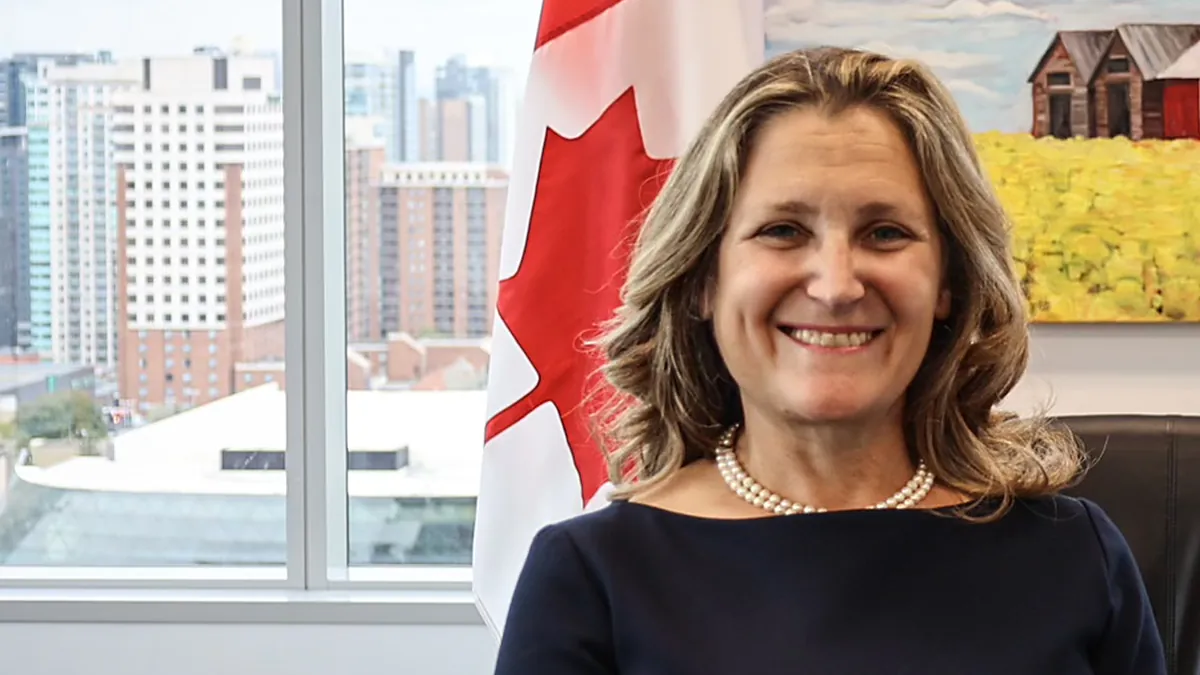
Chrystia Freeland announced on Jan. 5, 2026, that she will resign as the Liberal MP for University-Rosedale to become an unpaid economic adviser to Ukrainian President Volodymyr Zelensky. She confirmed two days later she would vacate her seat on Jan. 9, also giving up her role as Canada’s special representative for Ukraine’s reconstruction.
Zelensky makes the announcement
The news came first from Kyiv. On Monday, President Volodymyr Zelensky announced on social media that Freeland would serve as his adviser on economic development, saying she has “extensive experience in attracting investment and implementing economic transformations.”
Freeland confirmed the appointment the same day, saying the role will be unpaid. “Ukraine is at the forefront of today’s global fight for democracy, and I welcome this chance to contribute on an unpaid basis as an economic adviser to [Zelensky],” she wrote. “In the coming weeks I will also leave my seat in Parliament. I want to thank my constituents for their years of confidence in me. I am so grateful to have been your representative.”
Along with her seat in the House of Commons, Freeland said she would step down as Canada’s special representative for the reconstruction of Ukraine, the role she took on last September after leaving cabinet.
Opposition says she has to choose
The announcement immediately drew fire from the opposition benches, where Conservatives and New Democrats alike argued a sitting member of Parliament cannot also advise a foreign government.
Conservative foreign affairs critic Michael Chong put it bluntly: “one cannot be a Canadian MP and an adviser to a foreign government. She must do one or the other.”
Conservative ethics critic Michael Barrett raised a sharper concern, suggesting Freeland could access sensitive information while advising a foreign government at the highest levels. “Beyond the fact that serving Canadians is not a part-time job, the position she has accepted with a foreign government, paid or unpaid, raises the question of whose interests will be prioritized,” he wrote. Interim NDP leader Don Davies joined those saying Freeland should have resigned before accepting the post.
The date moves up: Jan. 9
The pressure worked quickly. On Wednesday, Freeland announced she had written to the Speaker of the House of Commons to confirm she would vacate her seat effective Friday, Jan. 9 — well ahead of the “coming weeks” she had first described. She said she had consulted the federal ethics commissioner “throughout” the process of accepting the Ukraine role “and followed his advice.”
“It has been an immense honour to serve my constituents and all Canadians in Parliament since 2013,” she wrote. “Last fall, I stepped down from Cabinet and announced that I would not be seeking re-election, and that I would be taking on new full-time professional roles outside politics.”
Prime Minister Mark Carney, speaking to reporters in Paris on Tuesday, said he had not asked Freeland to stay on as an MP to protect the stability of his minority government, and that he believed taking the Ukraine role meant she should give up her seat. “My judgment was that taking that role would be consistent with resigning as an MP, and I welcomed her doing that,” he said. Carney now has 180 days to call a byelection for University-Rosedale, the downtown Toronto riding Freeland has held for the Liberals since 2015, and he told reporters he expects to call “a few byelections” soon.
The end of a long run in Ottawa
Freeland’s departure closes one of the most prominent careers in modern Canadian politics. First elected in a 2013 byelection, she served as minister of international trade and then foreign affairs under Justin Trudeau, helped renegotiate the North American free trade agreement during Donald Trump’s first term, and in 2020 became the first woman appointed Canada’s finance minister, steering the country’s finances through the pandemic. Of Ukrainian heritage and a vocal supporter of Kyiv, she was placed on a Kremlin blacklist in 2014.
Her exit from the front benches began in December 2024, when her public resignation as finance minister and deputy prime minister helped force Trudeau’s own departure. She ran against Carney for the Liberal leadership last spring, then served in his cabinet as transport minister before leaving in September to become his special representative for Ukraine’s reconstruction, announcing at the same time that she would not seek re-election.
The Ukraine advisory role is not her only next step. In July, Freeland will become chief executive of the Rhodes Trust, the Oxford-based educational charity that administers the Rhodes scholarships — a post announced in November. Between Kyiv and Oxford, one of Ottawa’s defining political figures of the past decade is trading Parliament Hill for the international stage.

