

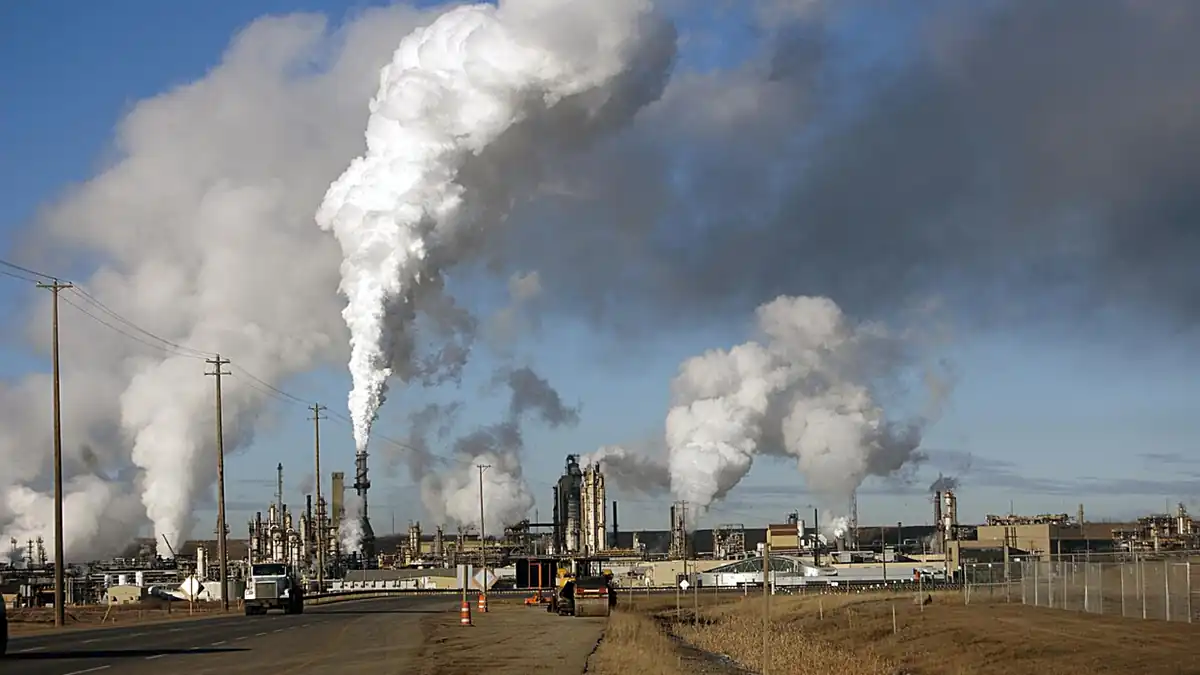
Venezuela holds the world’s largest proven oil reserves, 303 billion barrels of mostly extra-heavy crude similar to Alberta’s oilsands output, but its industry is producing only about 1.14 million barrels a day, and rebuilding it would require billions of dollars and years, so any pressure on Canadian heavy-crude prices is gradual, not immediate.
The largest reserves, a fraction of the output
The U.S. Energy Information Administration put Venezuela’s proven crude reserves at 303 billion barrels as of 2023, about 17 per cent of the world total and more than any other country. Saudi Arabia ranks second and Iran third. Canada ranks fourth, with 163 billion barrels, the vast majority of it in Alberta’s oilsands, according to Natural Resources Canada.
Reserves are not production. Venezuela reported output of 1.14 million barrels a day in November 2025, according to the Organization of the Petroleum Exporting Countries. Canada produced a record 5.13 million barrels a day in the first half of 2025, according to the Canada Energy Regulator — more than four times as much, from a smaller reserve base.
The gap reflects the nature of the oil and the state of the industry. Venezuelan crude is extra-heavy. Like oilsands crude, it does not flow easily, must be thinned before it can move by pipeline, and needs extra processing before it can be refined into gasoline or diesel. That is also why both sell at a discount to light oil such as Texas crude. Venezuela’s sector has also been weakened by budget limits, deteriorating infrastructure and the loss of experienced workers.
How Canada replaced Venezuela in the U.S.
In the mid-1990s, the United States was the largest buyer of Venezuelan crude, and Gulf Coast refineries were configured to run that heavy oil. That trade faded as U.S. shale brought large volumes of light oil to market, and then decisively when U.S. sanctions on Venezuela’s state oil company in 2019 all but stopped its exports to the United States.
Canadian producers filled part of the space left. About 400,000 barrels a day of Canadian crude can now reach the Gulf Coast — a small share of the 4.4 million barrels a day Canada exported to the United States overall as of October 2025, most of it to Midwest refineries also set up for heavy crude and tied directly to Alberta by pipeline.
China took most of the rest, receiving more than two-thirds of Venezuela’s crude exports as of 2023. Sanctions were eased in 2022, allowing Chevron to resume exports from its joint ventures with Venezuela’s state firm, and Venezuelan shipments to the Gulf Coast resumed in 2023 at about 135,000 barrels a day as of October 2025.
What a revival would cost
U.S. President Donald Trump has said Venezuela’s industry could be rebuilt in under 18 months with U.S. support, and the U.S. Department of Energy said it was selectively rolling back sanctions so Venezuelan crude could be sold in global markets, with oilfield equipment and U.S. diluent allowed into the country. Washington also aims to sell 30 million to 50 million barrels of sanctioned Venezuelan oil.
Independent estimates are far slower. Rystad Energy estimated US$54 billion in oil and gas investment over 15 years would be needed just to keep Venezuelan production flat. Further spending over two to three years could add about 300,000 barrels a day, while pushing beyond 1.4 million barrels a day would require another US$8 billion to US$9 billion a year.
There are commercial obstacles as well. ExxonMobil and ConocoPhillips were among the firms whose Venezuelan assets were nationalized under former president Hugo Chavez in 2007. Arbitration panels ordered Venezuela to repay both billions of dollars, and those debts remain uncollected. Benchmark oil was also trading below US$60 a barrel, limiting the appeal of adding supply to a well-supplied market.
The Canadian exposure is real but narrow
Analysts say a meaningful return of Venezuelan crude could weaken Canadian heavy-oil prices in the near term, and the price of Western Canada Select, Alberta’s main blend, did soften in the days after the U.S. move. Canadian oilsands shares also fell sharply on Jan. 5, with the Toronto Stock Exchange energy subindex down more than three per cent, although analysts quoted that day described any price effect as modest — in the range of US$2 to US$3 a barrel.
Pipeline geography limits the damage. Venezuelan crude arriving by tanker cannot readily displace Canadian crude delivered by pipeline to the Midwest. The more direct offset is on the sales side: Canada can send more crude to Asia through the Trans Mountain pipeline. That is why the debate in Alberta that week turned less to Venezuela than to how quickly Canada can build more routes to buyers outside the United States.

