

A Canadian-led study published Jan. 21, 2026 in Current Issues in Tourism found that under current warming, only 22 of 93 potential locations could reliably host a Winter Paralympics in March by 2050 — 16 by 2080 — and proposed earlier dates, a merged Games, multi-country hosts and better snowmaking as adaptations.
The Paralympics face the steepest decline
The research, led by Daniel Scott of the University of Waterloo with Madeleine Orr of the University of Toronto and Robert Steiger of Austria’s University of Innsbruck, builds on an earlier analysis of 93 locations the International Olympic Committee has identified as having the infrastructure for a Winter Games.
Under the current warming trajectory, roughly half of those locations could still reliably host the Olympics in February by mid-century. The Paralympics, held in March when temperatures are higher, fare far worse: 22 reliable locations by 2050, falling to 16 by 2080.
Scott said improving the reliability of the Paralympics should be a key priority before the 2038 Games are awarded. “That is the challenge that the (International Olympic Committee) and (International Paralympic Committee) has to really grapple with,” he said.
A location counts as “reliable” in the research if it can deliver sufficient snow depth and cold temperatures in nine out of 10 winters. Nearly half of the 21 places that have hosted the Winter Games to date would no longer meet that bar by mid-century.
Option one: merge the two Games
One strategy in the paper is unifying the Olympics and Paralympics into a single February event. A merger could boost sponsorship and visibility for the Paralympics, the study says, but it risks the Paralympic competition being overshadowed, and a combined Games would be so large and complex that smaller cities could be shut out of hosting altogether.
Option two: move everything earlier
The researchers found a simpler lever in the calendar. Shifting both Games earlier by two to three weeks nearly doubles the number of reliable Paralympic locations by 2080, with only a small reduction in the list of potential Olympic hosts.
“So that was really positive to find that maybe there are some workable solutions,” said Scott. “We’re putting some numbers to that strategy.”
Option three: share the Games across borders
The paper also floats regional or multi-country hosting, in which a major city partners with a smaller, climate-reliable mountain community — for example, Munich teaming up with an Austrian city for the snow sports. Scott even raised a “Quebec-New England” Games, where Montreal and Quebec City, which lack the elevation for a standard men’s downhill, would partner with Vermont or New Hampshire.
The idea has a history: an Innsbruck-centred bid spread across Austria, southern Germany and northern Italy was dropped in 2017 after voters rejected it in a referendum.
Snowmaking is not optional
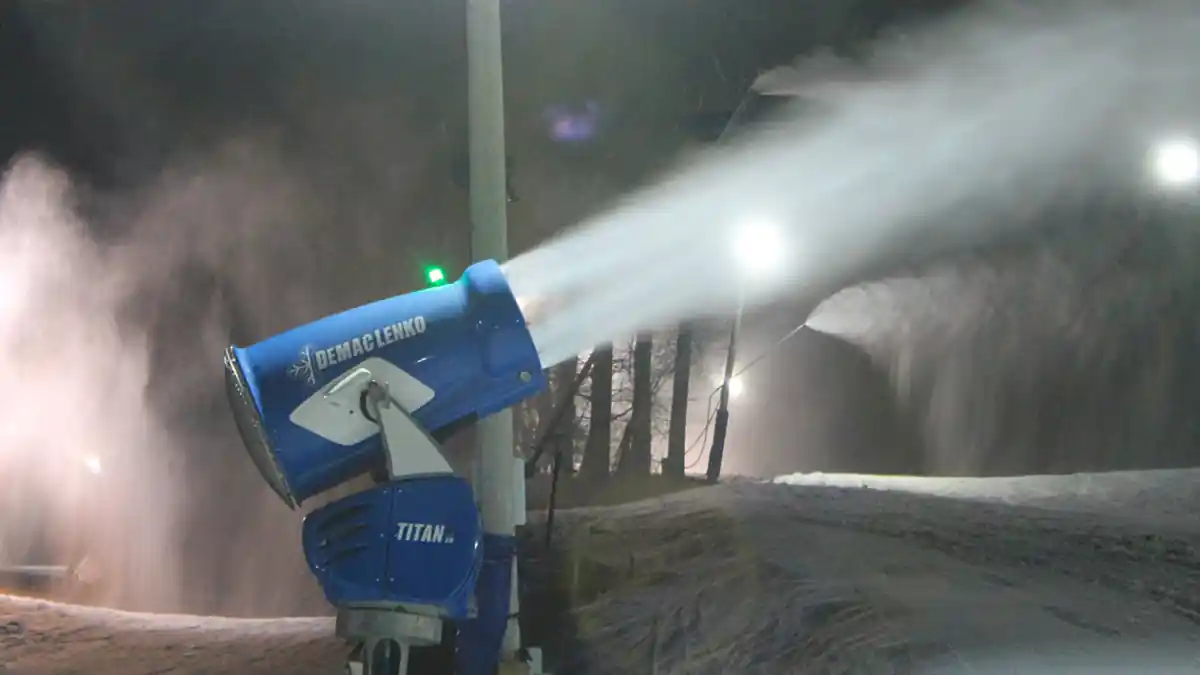
Whatever the format, the study concludes snowmaking will be critical. Without it, only seven locations could reliably host the Games today, dropping to four or fewer by mid-century. Snowmaking has been used at every Winter Games since Lake Placid in 1980, and Beijing relied on it almost entirely in 2022. Organizers of the Milan Cortina Games, which opened the following month, planned to produce about 2.4 million cubic metres of snow; when Cortina last hosted in 1956, no manufactured snow was used at all.
The study argues that banning snowmaking would condemn the Games to increasingly unfair and unsafe conditions, and says making snowmaking more sustainable must be a priority. In a statement, Orr, a sport ecology professor, said “no sport can escape the impacts of climate change,” and that the world’s best athletes deserve the best conditions that can be provided sustainably.
Where Canada stands
The outlook for past Canadian hosts is mixed. Calgary ranked among the most reliable locations in the world — one of only four that could still host a March Paralympics late in the century even under a high-emissions scenario. Vancouver, where rain and warm weather plagued the 2010 Games, becomes “climatically risky” by mid-century, although Scott noted the city could be reliable again if snow events were concentrated in Whistler or the B.C. interior.
The research has already influenced policy: after the team’s earlier findings were presented, the IOC paused the bidding race for the 2030 Games to further study climate effects, later commissioned Scott and Steiger to expand the analysis, and now requires snow venues to be climate-reliable until at least mid-century. The study says the list of dependable hosts grows by an additional 24 late-century Olympic locations if the world holds warming below two degrees.

